

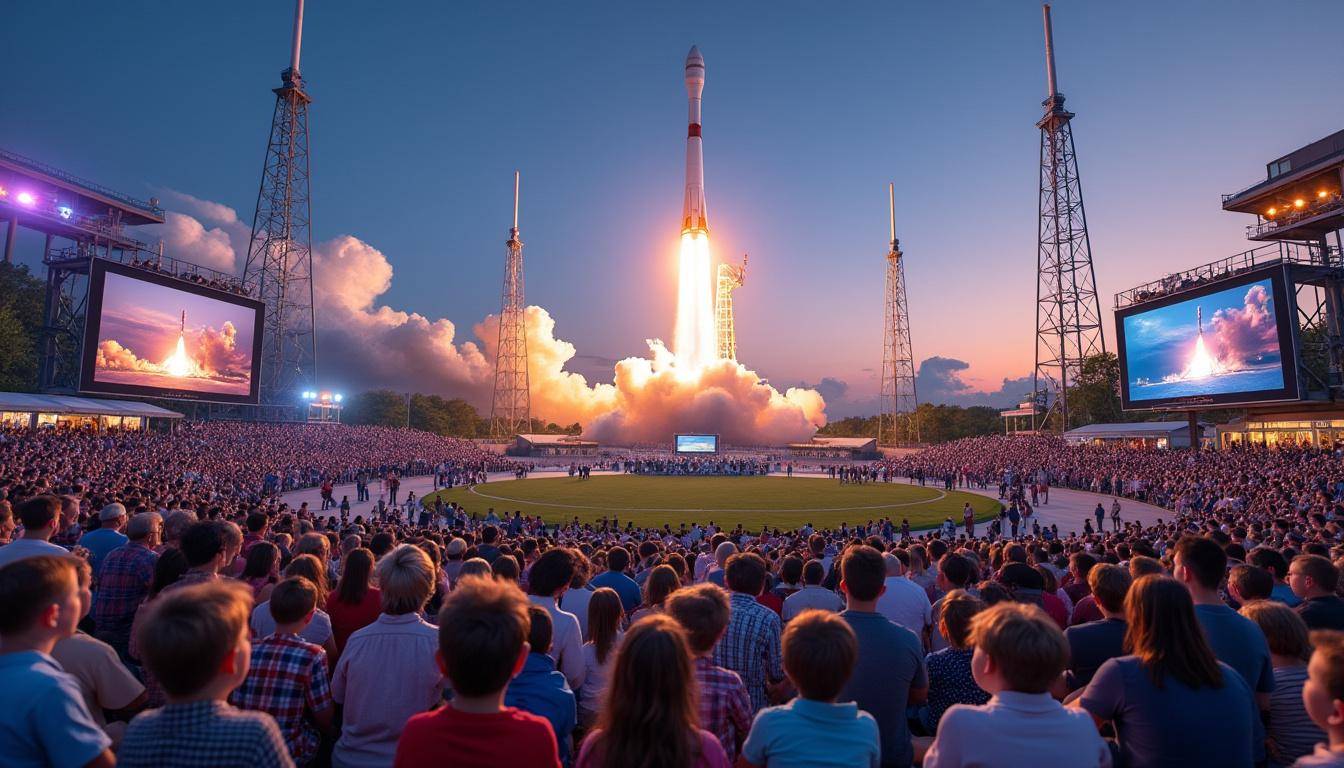
The Artemis II Launch Celebration at the US Space & Rocket Center gives you a direct way to live the next big NASA mission around the Moon. Instead of watching a rocket launch alone on a screen, you join hundreds of space enthusiasts inside a legendary space museum.
Artemis II Launch Celebration at the US Space & Rocket Center
The Artemis II Launch Celebration in Huntsville brings together families, students, and teachers inside the Davidson Center for Space Exploration. You follow the NASA mission broadcast while standing under the iconic Saturn V rocket that shaped early space exploration.
This watch party turns the Artemis II launch window into a full evening experience. Gates at the Davidson Center open in late afternoon so visitors settle in before the scheduled liftoff time around early evening local time.
What happens during the Artemis II launch celebration
During the Artemis II Launch Celebration, the main hall turns into a shared mission control room. Giant screens show live coverage of the rocket launch, including astronaut suit-up, final checks, and countdown milestones.
Visitors listen to NASA commentators explain every step, from engine ignition to separation events. This transforms the astronomy event into a guided lesson in real time.
Watching the stream in a crowd changes how students relate to science and space technology. They see adults and children react together to each moment, which strengthens long-term interest in STEM learning.
Why this Artemis II watch party matters for students
The US Space & Rocket Center watch party offers much more than entertainment. Teachers and parents use this Artemis II event to connect school subjects with a real NASA mission happening in front of their eyes.
Instead of learning about orbits, propulsion, or communication systems only from textbooks, learners see these concepts in action as the spacecraft travels toward the Moon.
Concrete learning gains from the Artemis II launch celebration
Each part of the rocket launch offers a teaching moment. Countdown procedures highlight precision and teamwork. Stage separation shows physics in motion. Mission timelines explain planning and risk management.
Teachers attending with their classes often prepare simple worksheets linked to the Artemis II watch party. They ask students to identify mission stages, list key numbers, and describe how astronauts stay safe in deep space exploration.
- Identify roles in the NASA mission team, from flight director to capsule communicator.
- Track main countdown points, including final polling and “go/no-go” decisions.
- Relate thrust, mass, and orbit altitude to what students learned in physics.
- Connect life support systems to biology and environmental science.
- Discuss how space technology later improves medical devices or communication on Earth.
This structure helps students see Artemis II as a large classroom in motion, not only as a one-time astronomy event.
Inside the US Space & Rocket Center watch party experience
The US Space & Rocket Center builds the Artemis II Launch Celebration around community. Families arrive early to explore exhibits before the watch party starts. Staff and volunteers guide visitors through Saturn V stages, lunar mission artifacts, and interactive space technology displays.
As the launch window approaches, visitors move into Saturn V Hall or a similar large viewing area. Seating is arranged so children see both the screens and the real rocket above them, which links past Moon missions with the new NASA mission.
A day in the life of a family at the Artemis II launch celebration
To follow a clear example, meet Sarah, a middle school teacher, and her 11-year-old son Eli. They arrive at the Artemis II Launch Celebration two hours before the planned rocket launch.
First, they walk through the historic gallery where Eli asks how the Apollo missions landed on the Moon. Sarah links those questions to what they are about to see from Artemis II, which will circle the Moon with four astronauts on board.
While waiting for the countdown, they join a short educator talk about the differences between Apollo and Artemis. Eli hears how new space technology improves safety and how the mission prepares for future landings. When the final minutes of the countdown begin, he understands what each step means, not only what it looks like.
How the Artemis II NASA mission strengthens STEM education
The Artemis II NASA mission provides a rare chance to make science and engineering feel personal for young people. By watching the rocket launch in a shared setting, students grasp the scale of work behind a single liftoff.
They see how mathematicians, engineers, programmers, medics, and communication experts all support the same goal. This helps them picture their own future roles in space exploration or related industries.
Linking Artemis II watch party content to classroom projects
After the watch party, teachers often extend the experience with simple but structured projects. These activities keep the Artemis II Launch Celebration alive in the weeks that follow instead of letting excitement fade in one evening.
Some schools create group missions where students design their own timeline for a lunar flyby. Others use free NASA resources to model trajectories or test how different materials handle heat during reentry using small experiments.
Parents also join in. At home, families replay clips from the launch and ask children to explain what is happening. This role reversal, where the child becomes the “expert,” builds confidence and deeper understanding.
Space exploration history and the Artemis II launch celebration
The US Space & Rocket Center provides a rare historical frame for the Artemis II Launch Celebration. Visitors stand under the Saturn V, which represents Apollo, while watching a new NASA mission aimed at a sustainable return to the Moon.
This contrast shows how space technology has changed across decades. Children notice differences in spacecraft design, astronaut suits, and mission goals. Educators highlight how each generation learns from previous flights to improve safety and performance.
Why this astronomy event inspires long-term curiosity
Public astronomy events like this launch celebration give students a timeline of human progress. When they see Artemis II follow paths first taken by Apollo, they understand science as a continuous effort, not isolated breakthroughs.
Many visitors remember where they were during important launches. Attending the Artemis II watch party helps younger generations form their own “where were you” memory linked to science, not only entertainment or sports.
This type of memory turns interest in space exploration into something personal and durable.
Practical tips to enjoy the Artemis II watch party with your child
To make the most of the Artemis II Launch Celebration at the US Space & Rocket Center, plan the experience like a field trip. A bit of preparation turns the rocket launch into a structured learning moment for your child.
Parents and educators who guide students through the event before, during, and after notice stronger engagement and better recall of key ideas.
Simple steps before, during, and after the launch celebration
Preparation before the watch party helps children follow what they see. During the event, short conversations keep them active instead of passive. After the launch, a brief recap locks in understanding.
You do not need advanced technical knowledge to guide your child. You only need a structure and a few targeted questions.
Here is a simple sequence you use around the Artemis II Launch Celebration:
- Before: Watch a short explainer video on Artemis II and note three questions your child wants answered.
- Before: Review a basic diagram of the rocket so liftoff and staging make sense.
- During: Ask your child to point out when they hear key moments like “T-10 minutes” or “liftoff.”
- During: Encourage them to describe what they think the astronauts feel inside the capsule.
- After: Have them draw or write a short “mission log” entry as if they were on board.
- After: Rewatch a highlight clip at home and let your child explain the steps in their own words.
These simple actions turn the Artemis II watch party into a guided learning cycle instead of a one-time spectacle.
From Artemis II launch celebration to future space careers
When students attend the Artemis II Launch Celebration, they meet professionals who support space exploration from many angles. Museum staff, engineers, and educators often share their own stories and study paths.
Hearing those stories next to a live rocket launch broadcast helps young visitors see a direct line from today’s school subjects to tomorrow’s missions.
How one launch watch party shapes a student’s direction
Consider Eli again, now back at school after the US Space & Rocket Center watch party. During science class, he chooses a project on communication delays between Earth and the Moon, inspired by something he heard during the NASA mission broadcast.
His teacher helps him research how signals travel and how mission control handles delay. Eli presents his findings to classmates who also watched the Artemis II launch, so they connect his project to their shared memory of the event.
Experiences like this plant seeds for future study in engineering, physics, computer science, or even mission planning and policy. A single astronomy event begins to shape a long-term path.