Educational access for children in conflict is not only a right. It is a lifeline that protects learning, mental health and the future of entire communities.
Maintaining educational access during conflict and displacement
When conflict breaks out, schools close, families flee and children lose structure overnight. Yet maintaining educational access during conflict and displacement protects children from violence, exploitation and long-term poverty.
Today, hundreds of millions of children experience crisis, with many completely out of school. In some regions, attacks on schools and teachers have reached record levels, and learning spaces are destroyed or occupied by armed groups. Without fast emergency education, interrupted schooling quickly turns into permanent exclusion.
Educational access in conflict also supports social stability. Children who stay in school are more likely to develop skills for peace, economic participation and civic engagement. For parents, temporary classrooms or learning centers offer hope and a reason to keep families together.
Why education in emergencies protects children
Emergency education combines learning with protection. Safe learning spaces reduce the risk of recruitment by armed groups, early marriage, child labor and trafficking. Structured routines help children regain a sense of normal life amidst chaos.
For example, in several conflict-affected countries, temporary schools inside camps reduced child labor rates and increased girls’ attendance. When teachers receive training in child protection, they identify abuse earlier and link families to services. Education becomes the entry point to health, nutrition and legal support.
Maintaining educational access in emergencies is not a luxury for later reconstruction. It is an immediate humanitarian priority that saves lives in the present and reduces the risk of renewed conflict in the future.
Inclusive education and protection for displaced children
Displacement breaks social networks and disrupts school systems. Refugee and internally displaced children often face language barriers, missing documents and discrimination. Inclusive education policies decide whether these children learn or stay excluded.
Host countries that open public schools to refugee learners, adapt curricula and train teachers in multicultural classrooms keep educational access alive. When admission does not require birth certificates or previous transcripts, displaced children reenter school faster and with less stigma.
Practical guidelines from resources such as federal policies supporting immigrant and refugee access offer useful parallels for crisis-affected children worldwide. They show how laws, funding and local school practices align to protect the right to learn.
Addressing special and diverse learning needs in conflict
Children with disabilities or learning difficulties face double exclusion during conflict. Physical barriers, loss of assistive devices and untrained staff increase the risk of permanent dropout. Inclusive education in crises requires specific strategies for these learners.
Simple measures such as ramps, visual schedules, peer buddies and flexible pacing keep more children engaged. Teacher training on special educational needs and trauma-aware instruction is essential. Many approaches developed for peaceful contexts, such as those described in strategies for learners with special educational needs, adapt well to emergency classrooms.
When displaced children see their diverse needs recognized and supported, they experience school as a safe place, not another source of exclusion. This sense of belonging strengthens both learning and protection.
Psychosocial support and resilience through education
War and forced displacement expose children to loss, fear and chronic stress. Without structured psychosocial support, these experiences affect concentration, memory and behavior. Education offers one of the most effective paths to healing and resilience.
Teachers trained in basic psychosocial skills help children name emotions, manage anxiety and rebuild trust in adults. Activities like group games, drawing, storytelling and cooperative projects strengthen peer relationships and give children tools to cope. In many conflict-affected contexts, school is the only reliable place where children feel heard and seen.
Resilience grows when children experience safety, connection and a sense of future. Educational access provides all three: a predictable routine, supportive relationships and visible progress through learning new skills.
Practical classroom strategies for psychosocial support
Teachers in conflict settings often feel overwhelmed. Simple, low-cost routines already provide strong psychosocial support. Short check-ins at the start of class let children share how they feel. Quiet corners give space to calm down when emotions rise.
Group rules created with students increase trust and predictability. Short relaxation exercises, breathing, or stretching between lessons reduce physical tension. Lessons that invite personal reflection, such as writing about hopes and goals, rebuild a sense of direction.
- Start of day check-in with a simple mood scale or emojis drawn on the board.
- Peer support pairs so no child faces tasks alone, especially after new arrivals.
- Routine closure at the end of class to name one thing learned and one thing appreciated.
- Safe talk time where children know when and where they can speak privately with an adult.
These methods protect mental health and keep classrooms stable enough for learning to continue, even during prolonged conflict.
Humanitarian aid and emergency education systems
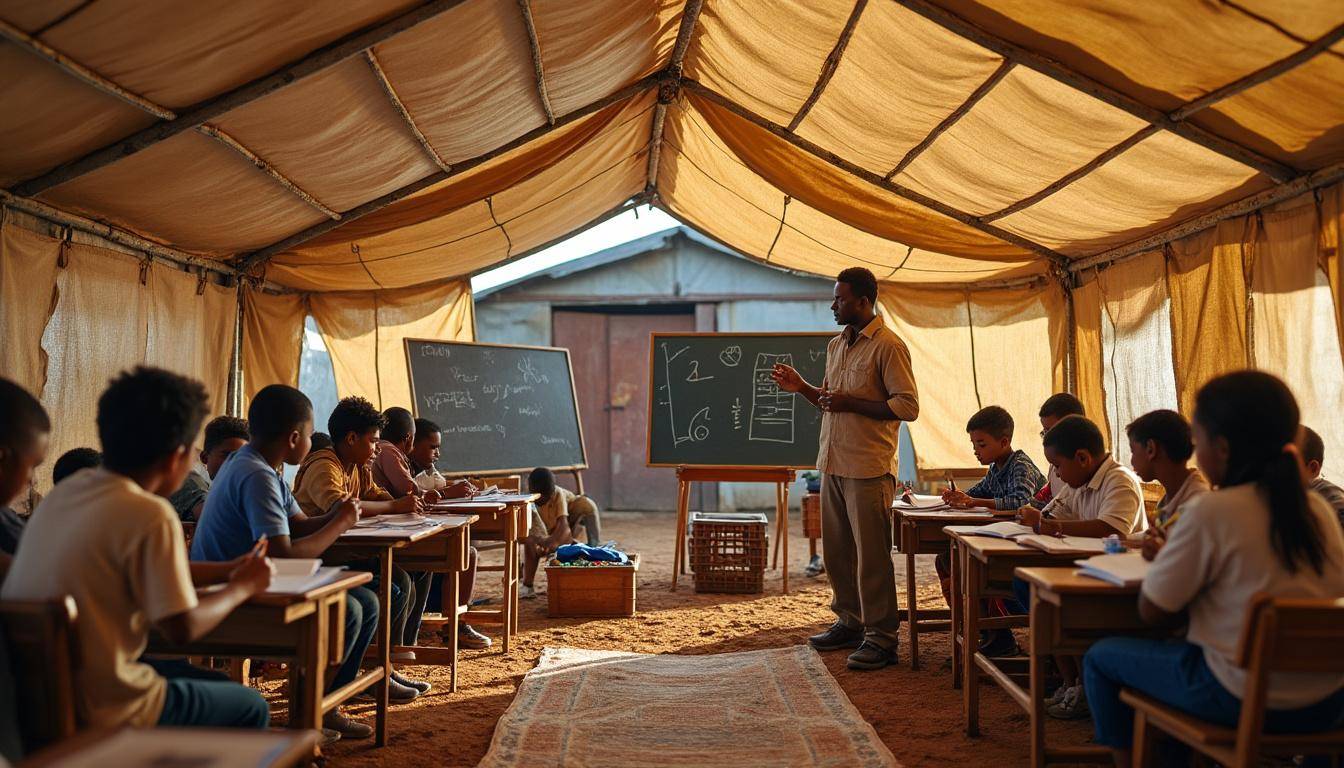
Maintaining educational access in conflict zones depends on coordinated humanitarian aid. When education is included from the first days of a crisis, children return to learning faster and lose less ground. Tents, learning kits and local teacher incentives often make the difference between months of idleness and a functional school day.
Global partners now combine rapid response with long-term system strengthening. They help ministries of education plan for risk, stock emergency materials and design curricula that can shift between in-person, radio and digital learning. This mix of speed and planning is central to education system resilience.
Lessons from other contexts, including how communities expand school options during disruption as seen in resources like guides on school choice and alternative pathways, offer practical ideas for flexible learning during crisis.
Key components of effective emergency education
Strong emergency education programs often share similar features. They prepare for conflict before it starts, respond quickly when it does, and stay connected to national systems so short-term solutions support long-term recovery.
Effective models usually include:
- Rapid learning spaces such as tents, converted community buildings or shaded outdoor areas.
- Adapted curricula with condensed content, life skills and peace education.
- Teacher support through stipends, training and supervision to reduce burnout.
- Flexible schedules that fit with water collection, food distribution and security conditions.
- Safe school routes planned with communities to reduce exposure to violence.
When these elements align, educational access becomes one of the strongest forms of protection in humanitarian response.
Building resilient education systems in fragile and conflict-affected contexts
Resilience in education means the system continues to serve children during shocks and recovers quickly afterward. This includes conflicts, natural disasters and disease outbreaks. Effective planning accepts that crises will happen and prepares to keep learning going even under pressure.
Evidence from fragile states shows that schools linked to strong communities bounce back faster. Parent committees that participate in safety planning, school repairs and attendance monitoring keep children connected to learning even when formal structures weaken.
Policies that reduce inequality between regions and identity groups also lower the risk of renewed violence. When access to quality schooling is more equal, frustration and perceived injustice decrease, which supports more stable societies.
From crisis response to long-term opportunity
Emergency measures should prepare the ground for stronger systems after conflict. Temporary learning centers can transition into permanent schools. Accelerated learning programs help overage students rejoin age-appropriate grades. Investments in teacher training and local management continue to pay off long after the immediate crisis ends.
Some countries use recovery periods to review curricula and teacher recruitment, aiming for more inclusive and equitable models. This approach reflects the idea of an ideal educational pathway that remains flexible enough to accommodate disrupted schooling and late starts.
By planning with both emergencies and long-term growth in mind, education systems transform conflict from a permanent barrier into a difficult but temporary interruption in a child’s learning journey.