

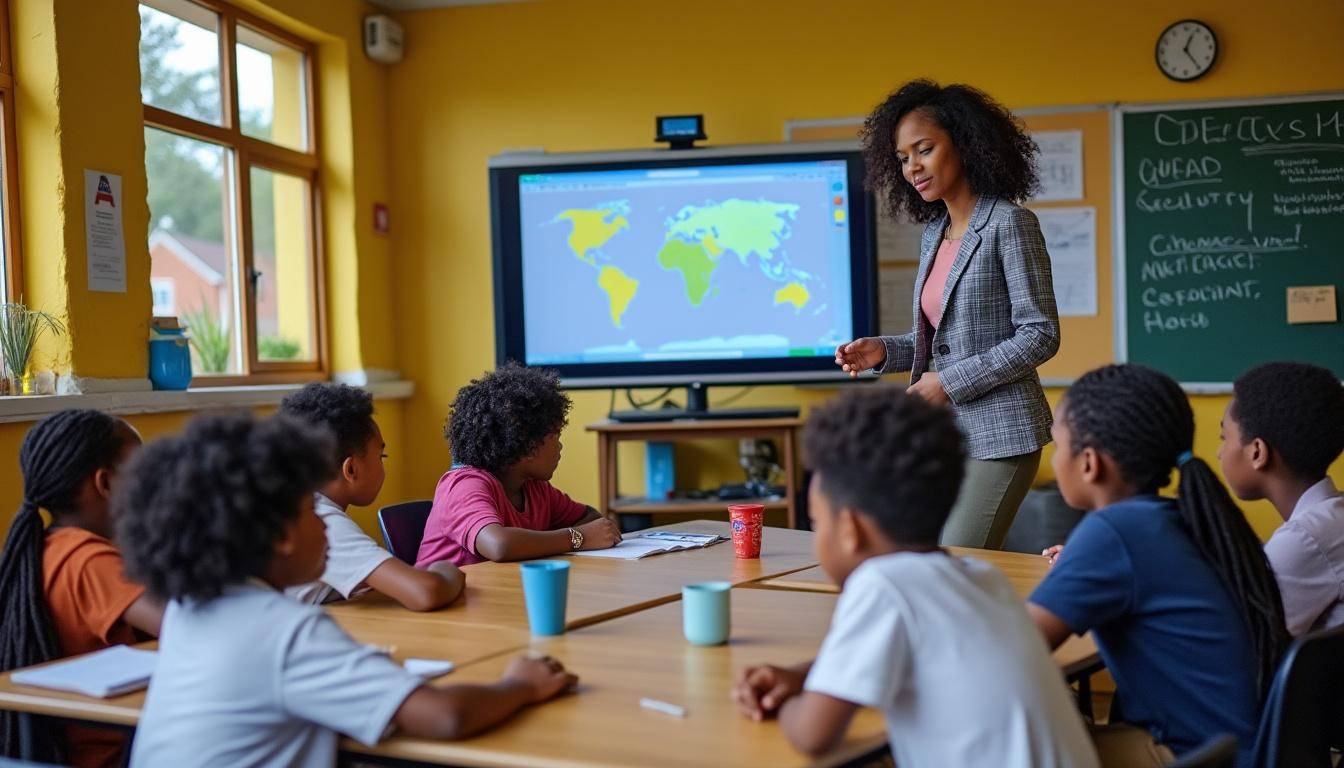
You see the headlines about low test scores. You hear the alarms about reading and math. Yet behind these numbers are Black children with dreams, talent and untapped strength. Focusing only on test scores hides who they are and who they want to become.
Moving beyond test scores to empower Black children
Across the United States, districts worry about declining test results. The National Assessment of Educational Progress reports the lowest reading performance in decades. For Black children, the gaps are even deeper, as shown by cities where fewer than one in three Black elementary students read at proficient levels while most white peers meet or exceed benchmarks.
These numbers highlight education equity problems, yet they do not define the worth or potential of any child. When educators and systems label Black students as needing only “skills remediation,” they ignore curiosity, creativity and ambition. This narrow focus on test scores often turns school into a place of judgment instead of a place of empowerment and growth.
Instead of asking, “How low are the scores,” the better question is, “How do we support student success and dream achievement for every Black child?”
Academic challenges and the danger of labels
When adults describe a child only through levels like “basic” or “below proficient,” the child hears a fixed story about their mind. This shapes identity. Many Black children already face academic challenges linked to poverty, under-resourced schools and biased expectations. Labels add another barrier.
Research on stereotype threat shows that when students feel judged through negative group stereotypes, performance drops and anxiety rises. In classrooms where Black children expect to be measured only by scores, they often avoid risk, speak less and stop seeing learning as a path to their goals.
These patterns are not about ability. They are about context. When schools shift from ranking to overcoming barriers with students, outcomes change.
Seeing Black children as advanced dreamers, not data points
Every child carries a picture of who they want to become. For some it is a journalist, for others an architect, engineer, artist or community leader. The role of adults is to see this inner picture and connect daily schoolwork to it.
Picture a boy who loves stories but struggles with handwriting and spelling. He hides his paper full of eraser marks under the desk. Instead of scolding, his teacher sits beside him on the floor, opens a notebook full of his own messy drafts and says, “Writers start like this. Your ideas matter.” In that moment, writing shifts from a test task to a tool for self-expression.
This is what happens when we treat Black children as advanced dreamers who face academic challenges yet hold strong potential. The adult response either shrinks or expands that potential.
From punishment to purpose-driven learning
Consider a student often in trouble who reads and writes below grade level. One day, instead of more punishment, a teacher asks, “Who do you want to be?” The student answers, “Like the journalist I see on television who talks to presidents.”
The teacher names the profession, guides the student to start a school newspaper, and links reading and writing to interviews, revision and publication. Over time, this young person writes more than ever before, not for a grade but for purpose. The test scores start to rise, yet the bigger shift is internal confidence.
Purpose turns drills into tools. When learning serves a dream, effort feels worthwhile.
Education equity as dream achievement, not only score repair
Education equity often gets framed as closing gaps on charts. While data matters, real fairness goes further. It asks whether Black children receive experiences, relationships and opportunities that feed both skills and identity.
Programs that link literacy, creativity and community impact show how this looks in practice. Initiatives similar to the Formula E Street Child Fund highlight how learning tied to real-world issues motivates young people who were previously disengaged. When children see themselves solving problems, their belief in their future grows.
In the same spirit, community transformation projects show that when neighborhoods invest in youth as leaders, schools alone do not carry the entire responsibility. Equity becomes shared work across families, libraries, clubs and local organizations.
Stories of overcoming barriers behind the scores
History holds many examples of Black innovators whose childhood learning paths did not match test predictions. Some were told they were not suited for engineering. Others struggled with reading well into adolescence. Yet they persisted, supported by at least one adult who focused on strengths instead of scores.
Engineers who later designed popular inventions, architects behind major cultural landmarks and illustrators whose art fills children’s books often share similar early stories. Assessments described their gaps. Mentors saw their gifts. Without that second view, the world would have lost entire fields of creative work.
These stories remind us that student success includes perseverance, resilience, and problem solving, not only early proficiency in one subject.
Practical strategies to empower Black children facing academic challenges
To move beyond test scores toward empowerment, educators and families need concrete moves. Each day offers chances to lift or limit a child’s sense of possibility. The strategies below support both inclusive education and rigorous learning.
All of them rest on one belief: Black children deserve classrooms where their ideas, cultures and aspirations shape the learning process.
Start with dreams, then build skills around them
One key question opens doors: “What do you want to be or build in the future?” When children answer “architect,” “game designer,” “nurse,” or “author,” adults can use those answers to plan reading, writing and math tasks.
For example, a boy in a library says he does not want to read. When asked who wants to design the city of the future, his hand goes up. He starts with magnetic tiles, then reads a picture book on architecture with support. Week after week, he returns to read more because the content aligns with his dream.
This method respects academic challenges while refusing to let them erase motivation. Skills become a bridge, not a barrier.
- Ask about the child’s dream at least once a term.
- Find books, videos and mentors linked to that dream.
- Turn practice tasks into steps toward real projects.
- Celebrate progress in effort, not only in test results.
Use culturally relevant and arts-based learning
Books like stories of young Black protagonists handling school struggles show children their experiences on the page. When a character who looks like them deals with messy handwriting, spelling errors or fear of sharing work, the child feels less alone.
Arts integration also strengthens student success. Drawing, music, drama and storytelling help students express understanding in multiple ways, especially those who fear being judged on written accuracy alone. Approaches similar to child rights and arts education initiatives highlight how creativity supports both confidence and academic growth.
Resources such as arts education for children show how combining literacy with illustration, performance or digital media engages reluctant readers and writers. When creativity is honored, Black children see themselves as producers of knowledge, not only test takers.
Inclusive education and the role of families in empowerment
Inclusive education means more than placing diverse students in the same room. It involves shared power among teachers, students and families. Parents and caregivers of Black children often hold deep knowledge of their child’s curiosity, fears and dreams. Systems that ignore this knowledge miss a vital resource.
International projects, such as inclusive education efforts with refugee and marginalized children, show that when schools welcome family voices, attendance and engagement improve. These models underline the link between dignity, belonging and student success.
Family-focused initiatives, such as those described in parental empowerment in education, stress how parents who feel informed and respected advocate more effectively for fair resources and high expectations.
Strengthening home–school partnerships for Black children
Parents of Black children often experience school meetings as one-way lectures about deficits. Shifting to partnership means asking, “What do you see your child doing at home? What brings them joy? What are your hopes for them?” This reframes the conversation from problems to shared goals.
Programs similar to initiatives that empower parents through training and support show how workshops on homework strategies, emotional support and system navigation help families feel less isolated. Guidance such as resources for parents supporting their children’s education illustrates simple language and literacy routines that strengthen learning at home.
When families understand how education equity works and where to find help, they push schools to remove structural barriers instead of blaming children for gaps created by unequal conditions.
Building ecosystems for Black student success beyond test scores
Black children thrive when they experience a full ecosystem around them, not only a good classroom. Libraries, youth clubs, mentors, and digital platforms all shape dream achievement. When these spaces align, the message becomes consistent: “You belong here. Your goals matter.”
Youth-focused organizations similar to the work described in programs that prepare boys and girls for their futures show the impact of homework help combined with mentoring, sports, coding and arts. These environments often become safe places where Black children test leadership, voice ideas and recover from school-related stress.
Career guidance projects, such as those discussed in empowerment and better career choices, demonstrate how early exposure to different professions widens horizons. When children meet engineers, doctors, designers and activists who share their background, they gain concrete images of what is possible.
Redefining success for the future
By 2026, technology, work and civic life look different from what current tests measure. Automation reshapes jobs, and skills like collaboration, critical thinking and adaptability grow in importance. Any vision of student success limited to reading and math scores misses these shifts.
For Black children who face structural racism, success also includes the ability to question unfair systems, build supportive networks and lead change. Empowerment in education equips them to analyze information, tell their own stories and design solutions.
When adults center overcoming barriers and nurturing dreams, test scores become one small indicator among many. The deeper goal is dream achievement through confident, capable, socially aware young people who know their value and refuse to be reduced to numbers.