

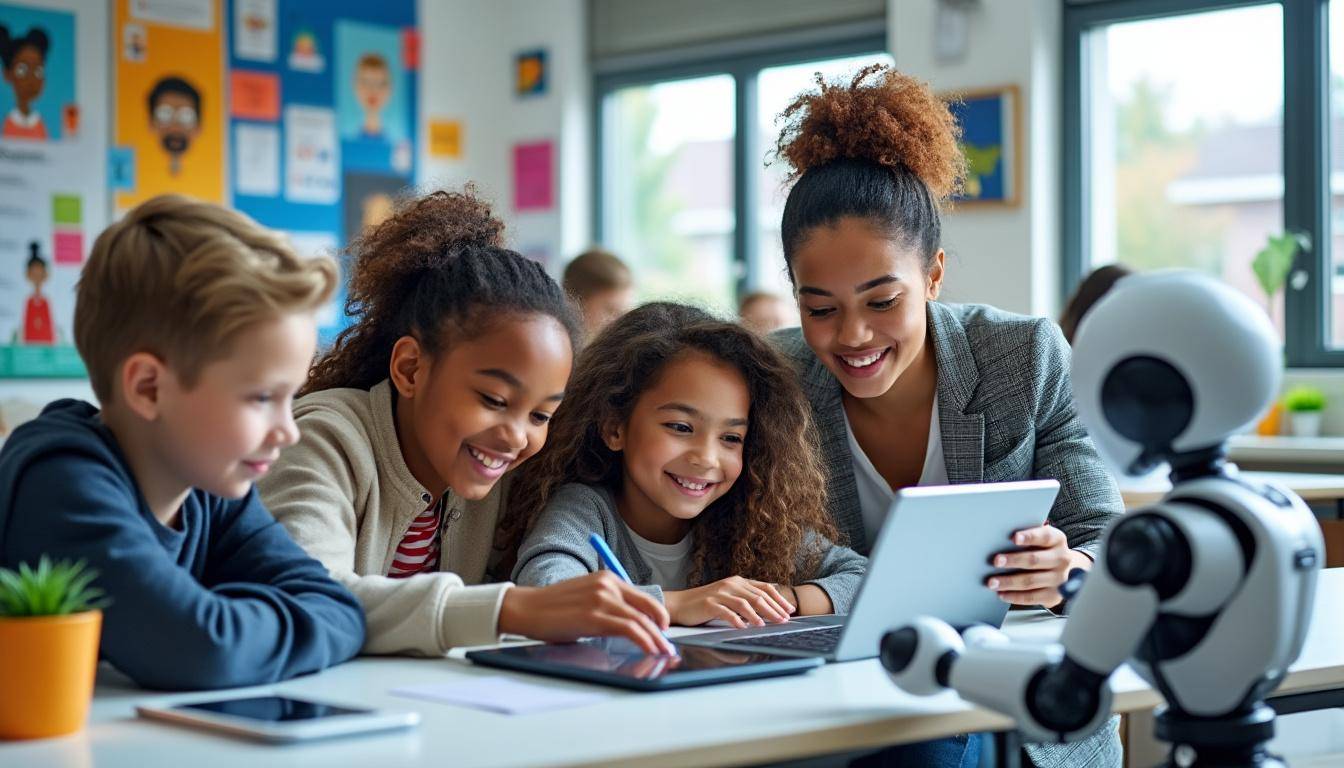
Generation AI grows up with smart devices, voice assistants and recommendation feeds. To protect every child, education must ensure strong computing skills, critical thinking and fair technology access for all learners, not only for a lucky minority.
Generation AI and why computing skills matter for every child
Children like Joseph, 10, in a Cambridge coding club already train simple AI models to sort drawings of apples and smiles. He sees when the AI gets it wrong and knows he needs to retrain it. This is what true AI education looks like in Generation AI: children see the system, not magic.
Many adults still treat AI systems as black boxes. When students leave school without basic digital literacy, they lack agency in a world shaped by automated decisions on finance, health or welfare. Strong computing skills in child education give them language to question and correct these systems.
From AI natives to critical AI thinkers
Being an AI native means exposure, not understanding. Many children use generative tools to write stories or solve maths, but few understand what training data, bias or hallucination mean. Without guidance, they accept answers that sound confident but contain errors.
Joseph did not want an AI to write his game. He wanted to stay in charge, because he knew the system might be wrong. This attitude is the goal of AI education: children stay in control, tools support them, and they learn how to fix problems rather than follow outputs blindly.
Digital literacy and equity in education for Generation AI
Experts warn of a “big split” between children who understand how AI works and children who never receive structured teaching. This split tracks existing inequalities in technology access, income and school quality. Equity in education now includes equity in digital literacy.
In many countries, exam entries in computing fell while usage of AI tools surged. Young people scroll through algorithmic feeds and use chatbots for homework, but fewer study computer science formally. This mismatch weakens the future workforce and widens gaps in opportunity.
How digital literacy protects rights and voice
Automated systems already influence what job offers you see, what loans you receive and how public services treat your family. For Generation AI, these systems will shape most adult decisions. Without basic computing skills, you cannot ask the right questions or appeal decisions.
Strong digital literacy allows young citizens to ask: What data did this system use? Who audits it? What happens if it gets things wrong? Equity in education means every child learns these questions early, not only students in elite schools.
Coding for kids in Generation AI: still essential
Some leaders argue that coding will fade because AI writes code. Large models already automate a high share of routine programming inside tech firms. “Vibe coding” with natural language instructions is common in 2025 and 2026, including in schools.
This trend leads to a dangerous message for child education: if AI writes code, children no longer need coding for kids lessons. Teachers hear this and ask if they should drop computer science. That choice would weaken an entire generation’s understanding of how digital systems work.
Why coding for kids still matters in an AI world
Coding for kids is not only about training future programmers. It teaches logic, debugging, problem breakdown and persistence. Children learn to predict what a system will do and to adjust instructions until it works. These are core skill development goals for Generation AI.
When children use AI assistants to generate code, knowledge of basic structure helps them judge outputs. They test code, spot subtle errors and adapt solutions. Without this base, they treat generated code like magic spells and cannot fix problems when systems fail.
- Sequencing: Children learn to break tasks into ordered steps.
- Debugging: They practice finding and fixing mistakes instead of giving up.
- Abstraction: They learn to focus on what matters and hide complexity.
- Algorithms: They design simple processes to solve repeatable problems.
- Collaboration: They build projects together and explain their thinking.
These ideas support reading, maths and science. For Generation AI, coding fluency is as central as literacy and numeracy.
Practical models of AI education for primary and middle school
Schools do not need advanced robots to teach strong computing skills. Simple projects like Joseph’s apple versus smile classifier introduce core AI ideas with drawings and simple data tables. Children see that AI learns patterns from examples and fails when examples are poor or biased.
Clubs and enrichment tools help. For instance, game-like courses similar to interactive Roblox learning experiences mix storytelling, missions and coding challenges. Children build simple simulations and see how algorithms change outcomes.
Key components of strong AI education for kids
An effective AI education track for Generation AI includes several layers that build on each other. You start with curiosity and simple projects, then progress toward critical questioning and ethics. Each layer supports the next one.
By combining class lessons, clubs and online platforms, schools create consistent exposure without overwhelming children. Families support this with simple home projects that link AI to daily life, like questioning streaming recommendations or voice assistant answers.
Skill development for the future workforce in Generation AI
The future workforce will mix human judgment with automated systems. Reports from industry and global organisations highlight two groups of abilities: technical literacy and human “power” skills. Generation AI needs both to thrive.
On the technical side, students need understanding of data, security, privacy and simple algorithm design. On the human side, they need curiosity, adaptability, communication and continuous learning. Young people who blend these strengths will shape and supervise AI in the workplace, not be replaced by it.
Linking school projects to real-world AI use
Children engage more when they see how computing skills relate to real problems. Example projects include simple chatbots for school information, sorting algorithms to manage library books, or simulations of climate actions. When students run these projects with guidance on AI limits, they learn how tools support social goals.
Programmes that combine school and industry mentors show how AI shapes jobs in health, transport, media and public service. Students understand that skill development in coding, design and ethics gives them entry to diverse careers, not only tech companies.
Reducing the AI divide through technology access and support
Equity in education depends on fair technology access. In many regions, some children have high-speed internet, laptops and home support, while others share one old device for an entire family. This divide directly affects Generation AI, because the same devices enable both learning and AI use.
Public policies that support device lending, community labs and low-cost connectivity reduce this gap. When every child accesses online platforms, from simple coding games to structured AI labs, they build shared foundations regardless of income.
Community tools and partnerships that support AI education
Schools do not work alone. Libraries, youth centres and NGOs play a key role in digital literacy for children who lack resources at home. Structured workshops in these spaces introduce coding for kids and critical AI thinking in informal settings.
Projects similar to gamified digital learning adventures support this approach. Children explore missions about climate, cities or health while they write simple code, adjust variables and see how digital choices change outcomes.
Designing child education policies for Generation AI
Education systems that treat computing skills like optional extras risk leaving many students behind. Experts in curriculum design argue for a universal digital literacy qualification on par with reading and maths. Every student should leave school able to use AI critically, not only operate apps.
Policies also need clear learning progressions from early primary to upper secondary. This includes playful algorithm games for young children, text-based coding in middle school, and basic data science and AI model exploration in later years.
Balancing AI tools with deep understanding
As AI tutors and marking tools enter classrooms, systems risk offloading too much thinking to automated assistants. Strong policy ensures that AI supports teachers instead of replacing core thinking work for students. For example, AI drafts feedback but students still write and revise by hand.
Curricula should include explicit lessons on how AI tools work, where they fail, and how to cross-check their answers. Children who learn to challenge their own AI assistants build habits that protect them when future systems influence legal, medical or financial decisions.
Practical tips for parents raising Generation AI
Families hold daily influence on how children relate to technology. You do not need a technical job to support skill development in Generation AI. Simple routines and questions are enough to encourage critical use instead of passive consumption.
Parents in communities with limited resources also find creative solutions. Shared devices in extended families, scheduled time at local libraries and community classes all contribute to stronger digital literacy without heavy cost.
Everyday strategies to build computing skills at home
Children respond well to clear, short activities instead of long lectures. You turn routine screen time into learning by adding small challenges. Over weeks, these moments build habits of questioning and experimenting with AI systems.
For example, when your child uses a recommendation feed, ask why those videos appear and what happens if they search different terms. When they ask a voice assistant a question, compare the answer with another source. Reference playful resources similar to interactive educational games to encourage exploration together.
Teachers as guides for Generation AI classrooms
Teachers face pressure to keep up with rapid AI change while handling exams and daily class management. Many feel unsure about how deep they need to go into machine learning. Support, training and simple classroom materials help them introduce AI education without becoming system engineers.
Professional development that combines short online modules with practical projects works best. Teachers test AI tools for planning, then gradually introduce them in student tasks with clear learning goals and guardrails.
Simple classroom practices to grow AI literacy
Effective strategies focus on discussion and reflection, not only on tools. For instance, students compare AI-generated answers with human-written ones, highlight differences and debate which is more trustworthy and why. This strengthens reasoning and ethics together with computing skills.
Teachers also draw links to other subjects. In history, students examine how previous technologies changed work. In civics, they explore news about AI in elections or public services. These cross-curricular links show that Generation AI is not a niche topic but part of every subject.
Interactive learning experiences that engage Generation AI
Children learn best when they experiment. Interactive platforms and games support child education in AI by providing safe sandboxes. They test ideas, break things and rebuild, while invisible scaffolding keeps them on track.
For example, scenarios similar to mission-based Roblox projects invite children to design cities, manage resources or protect ecosystems with basic code. Each mission links back to key digital literacy goals such as data use, fairness and collaboration.
From play to structured computing skills
Playful environments lower barriers for hesitant learners. Once children gain confidence through games, teachers transition them to more structured tasks like text-based coding or simple AI notebooks. The fun context remains, but expectations rise gradually.
This approach reduces anxiety around computing skills and helps reach students who might not sign up for a traditional coding course. Over time, it expands the pool of young people ready for further study in computer science, data or digital design in the future workforce.
A shared responsibility for Generation AI
Preparing Generation AI is not a task for schools alone. Governments, families, industry and civic groups all share responsibility for fair technology access, robust AI education and inclusive equity in education. Each group controls part of the environment children grow up in.
Partnership programmes, often built around engaging tools similar to story-driven digital learning platforms, show how these actors work together. When this coordination succeeds, every child, regardless of background, gains the computing skills, critical thinking and confidence needed to shape AI, not be shaped by it.