

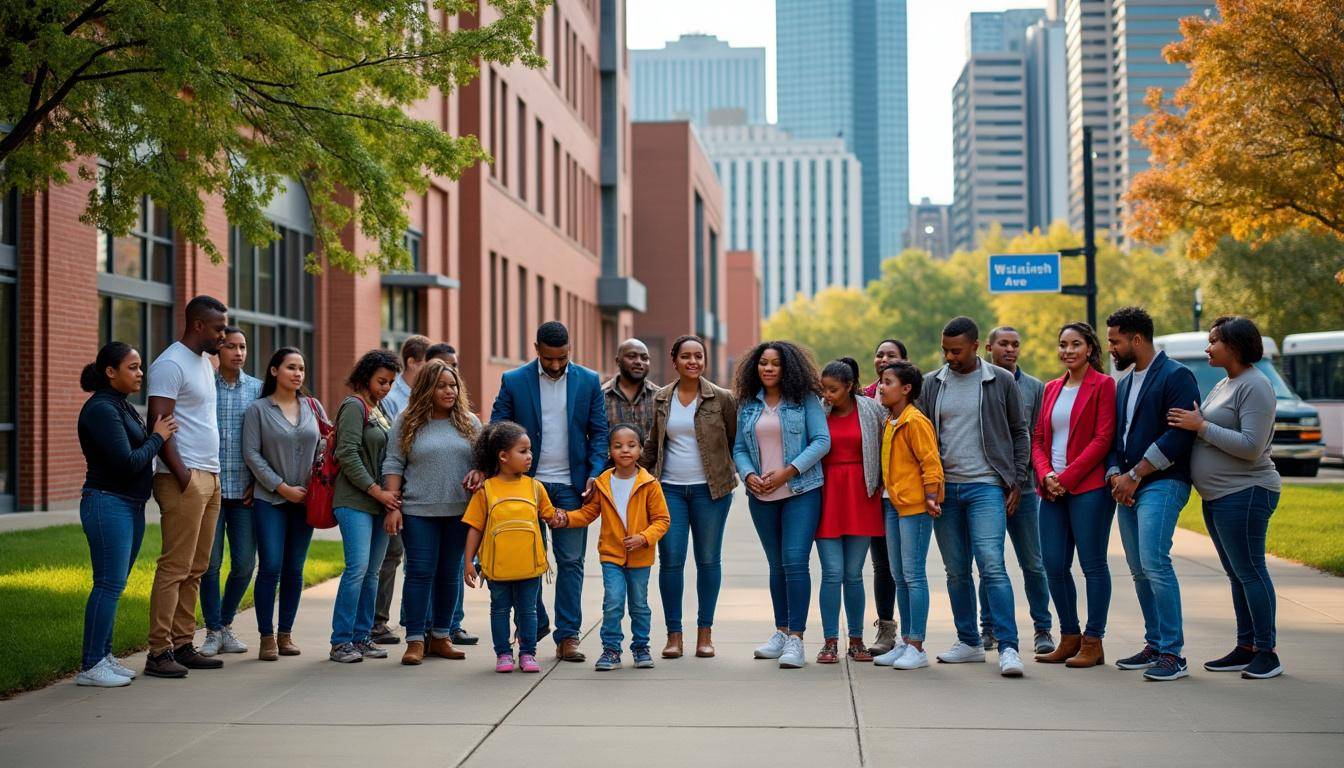
How Chicago Communities Rally When immigration agents Affect School Routines
The early-morning routine in neighborhoods like Little Village changed when masked federal officers began conducting highly visible operations. Community leader Baltazar Enriquez became a central figure in a grassroots effort: monitoring streets, coordinating pick-ups, and using loud whistles to warn families when immigration agents were nearby. Those local actions are part of a larger pattern that has reconfigured how families and schools approach safe school access in Chicago.
Data collected through November of that year showed clear, if uneven, effects on student attendance. On some days whole blocks of a neighborhood stayed home. On others, attendance rebounded as families and volunteers reestablished routines. These fluctuations reveal a complex interplay between fear, resilience and a community’s determination to keep children engaged in education.
Root causes and immediate effects
Several factors combined to create volatile conditions in neighborhoods targeted by enforcement: surprise operations, the use of unmarked vehicles, and an apparent focus on areas near schools and transit hubs. When families perceived their neighborhoods were being patrolled, the immediate reactions included missing school, changing routes, and shifting pickup plans.
- Fear of detention: Parents delayed drop-off or stayed home entirely rather than risk interaction with agents.
- Disrupted routines: After-school pickup arrangements were altered, often leaving children awaiting alternative supervision.
- Community surveillance: Neighborhood volunteers instituted watch teams and radio chains to share real-time information.
These local reactions had measurable academic implications. Some schools saw short-lived attendance declines; others registered sustained dips when families perceived a persistent threat. That pattern echoes reporting and analysis about how enforcement campaigns can depress school attendance, as documented in coverage of the attendance impacts of raids.
Community-led practices that reduced harm
In response to the threat, residents formed rapid response networks. Many of these tactics were low-tech and highly effective: text trees, whistle brigades, and volunteer drivers became the backbone of ensuring children could still reach classrooms. Community organizations also coordinated with schools to update families about safety protocols and to assert that schools remained safe spaces for learning.
- Volunteer transport: Organized carpools and supervised walking groups helped students avoid risky transit points.
- Real-time alerts: Messaging channels provided up-to-the-minute warnings and reassurance.
- Legal and educational advocacy: Community groups urged school officials to mark absences as excused when safety was the reason, protecting families from truancy penalties.
These grassroots efforts demonstrated that communities can mobilize quickly to protect children and keep them connected to school. Yet, they also highlighted structural gaps—such as the lack of a temporary remote-learning policy—that left volunteers filling roles historically handled by institutions. The experience of Little Village illustrates both the strain and the ingenuity of local responses to enforcement pressures.
Insight: Rapid, community-based responses can blunt the immediate educational harm caused by enforcement activity, but lasting protection requires institutional alignment between schools, advocates, and policymakers.
Organizing ‘Magic School Buses’ and Walking School Buses: Practical Strategies for Safe School Access
When families said they were afraid to walk their kids to class, volunteers and community leaders invented solutions. In Little Village, a fleet of drivers coordinated to transport more than 60 students daily; in Albany Park and Logan Square, residents assembled large walking groups. These are not fanciful interventions—they are practical logistics driven by an urgent educational imperative.
Organizers developed simple but robust operating procedures to ensure safety, accountability and trust. That structure allowed parents like Maria, who lost time with her partner due to detention, to continue sending her six‑year‑old to school without daily fear.
Key components of a sustainable volunteer transport model
Designing a durable “magic school bus” or walking school bus requires attention to safety, communication and legal risk.
- Clear roles: Drivers, route leaders, and communication coordinators must have defined responsibilities.
- Documentation: A roster and simple sign-in process helps manage accountability for each child on a route.
- Training and orientation: Volunteers should receive basic child-safety and de-escalation guidance.
- Coordination with schools: Principals and attendance staff must be informed daily about who is using community transport.
Beyond the logistical pieces, organizers embedded an educational mission within their work. Volunteers used travel time to read with children, practice Spanish or English vocabulary, and turn a logistical necessity into an added learning opportunity. This aligns with broader guidance about how communities can protect educational continuity in the face of enforcement, outlined in resources like strategies for protecting children during enforcement operations.
Examples, roles and scaled impact
Some concrete roles that emerged in Chicago neighborhoods illustrate scalability:
- Route captain: Plans the route and confirms volunteer availability each day.
- Safety marshal: Monitors intersections and communicates with route captains about any hazards.
- Family liaison: Keeps parents updated and ensures permission and contact information are current.
- Data recorder: Logs attendance and reports trends to school officials to ensure absences are excused if necessary.
Volunteer models also created community cohesion. In Logan Square, volunteers with whistle brigades and yellow vests signaled solidarity; in Little Village, the transported students’ return to classrooms produced visible joy and accelerated social reintegration after weeks of isolation. These tangible outcomes show that community logistics do more than get children to school—they restore a sense of normalcy crucial for learning.
Insight: Thoughtful volunteer transport models can preserve academic continuity and foster social-emotional recovery for students by turning necessity into a community-centered educational practice.
Volunteers often record simple how-to videos to train new route captains and to share best practices across neighborhoods.
How Schools, Teachers and Unions Step Up: Advocacy, Rights and Educational Continuity
School staff became frontline stabilizers as federal enforcement increased. Principals, counselors and teachers adjusted practice to address both legal and emotional fallout. The Chicago Principals & Administrators Association and the Chicago Teachers Union played pivotal roles in translating advocacy into day-to-day protocols to protect students’ rights.
District guidance permitted excused absences when safety concerns were documented, which helped families avoid the threat of truancy letters. Yet, the absence of an official remote-learning option forced teachers to improvise. Many created video tutorials and flexible assignment plans to ensure students who stayed home could continue learning without penalty.
Practical classroom adaptations
Teachers and staff developed multiple approaches to support students both in-class and at home.
- Take-home packets and digital tutorials: Step-by-step video lessons allowed absent students to follow curriculum at their own pace.
- Regular outreach: Bilingual teachers and family liaisons made wellness calls to check on families’ needs and to coordinate resources.
- Trauma-informed practices: Counselors introduced class circles and calming routines to help children process what they’d witnessed.
District staff also advocated for clearer policies. Community leaders like Fanny Diego Alvarez emphasized that schools were not designed to operate in isolation; partnerships with nonprofits and legal aid were essential. Evidence from similar situations suggests that formal partnerships between schools and community groups produce sustained improvements in attendance and student well-being, a model described by organizations focused on safe school environments such as models of safe, inclusive schools.
Legal, union and policy advocacy
The teachers’ union helped staff understand their rights and the limits of federal authority on school property. Trainings covered how to respond to enforcement presence, how to document incidents, and how to support families in accessing legal help. These trainings reduced panic and gave staff a framework for consistent, protective action.
- Documentation protocols: Staff learned to record when agents appeared and what actions were taken to protect students’ privacy and safety.
- Advocacy channels: Schools developed scripts and translated letters that leaders sent to families to explain policies and reassure them about safety measures.
- Community law partnerships: Legal clinics and immigrant-rights organizations provided consultations that helped families understand their options.
Schools that adopted these layered strategies—administrative guidance, union support, and community partnerships—sustained attendance better than those that did not. This combination also reinforced a crucial message: schools are caretakers of both learning and safety.
Insight: Integrating legal advocacy, union training and flexible instructional design is essential to protect students’ educational continuity when enforcement activity threatens the school ecosystem.
Student Activism and Mental Health: How Young People Keep Education and Rights Central
Students themselves have been powerful agents of resilience. In Little Village, high school senior Lia Sophia Lopez organized a walkout that galvanized hundreds of peers. That action was not merely protest; it functioned as peer support, helping students process fear and reclaim agency over their school experience.
At the same time, the trauma of watching family members detained, hearing sirens, or witnessing confrontations in their neighborhood deeply affects children’s capacity to learn. Schools and community groups expanded mental health services and peer-led supports to address these needs.
Forms of student-led support and their educational impact
Student activism took many forms, each with distinct educational benefits.
- Public demonstrations: Walkouts and marches reinforced civic learning and increased students’ sense of efficacy.
- Peer mentoring: Older students tutored younger ones to ensure that absences did not derail academic progress.
- Story-sharing circles: Structured forums where students could describe their experiences and access emotional support.
These activities strengthened school ties and reduced isolation. For example, when seniors led after-school study groups, younger students reported feeling more connected and were likelier to return to class after short absences. This dynamic shows how activism can be both a protective social mechanism and a pedagogical one.
Addressing mental health and long-term learning loss
To mitigate the psychological harm and learning disruptions, schools and partners implemented targeted interventions.
- Rapid-response counseling: Teams offered immediate support to students exposed to traumatic incidents.
- Catch-up instruction: Short, intensive learning modules helped students bridge missed content without stigma.
- Family-centered supports: Food distribution, housing assistance referrals, and legal clinics reduced household stress that undermines learning.
Students’ own advocacy also drew attention to broader cultural and curricular needs. Calls for curricula that celebrate identity and heritage—such as incorporating Latino heritage education programs—helped students feel seen and academically motivated. When learners recognize their histories in lessons, attendance and engagement often improve.
Insight: Student-led activism and embedded mental-health supports create a dual pathway: restoring safety and preventing long-term academic disengagement.
Policy Recommendations and Practical Steps to Sustain Safe School Access for Children in Chicago
Sustained protection of students requires a mixture of community energy, school policies and municipal leadership. The Chicago experience provides a menu of practical, evidence-informed recommendations that policymakers and education leaders can adopt.
Short-term, high-impact actions
Some interventions can be implemented immediately to stabilize school attendance and reassure families.
- Clear signage and space protections: Schools should post affirmative notices clarifying that school grounds and designated access points are not staging areas for enforcement.
- Excused absence protocols: Districts should standardize excused absences for safety-related reasons to avoid punitive truancy follow-ups.
- Community transport funding: Small grants can support volunteer driver stipends, fuel costs, and safety equipment for walking school buses.
Local advocates argued that specific, visible signs and district confirmations would reduce confusion about whether federal agents could use school parking lots. This administrative clarity builds trust and supports a safe learning environment.
Medium- and long-term strategies
To create enduring resilience, districts and city agencies should consider systemic changes.
- Formal partnerships: Schools should build lasting collaborations with community organizations and immigrant-rights legal clinics to route assistance quickly to affected families.
- Flexible instructional policies: Establish contingency plans that allow for remote instruction or approved alternative learning when local safety conditions pose clear threats to families.
- Investment in student services: Expand bilingual counseling, tutoring, and family resource centers to address the intersecting needs of socio-emotional support and catch-up learning.
Examples from elsewhere show how proactive measures prevent educational decline. Programs that integrate legal support, food assistance and mental-health care maintain stable attendance and reduce dropout risk—issues explored in analyses of how economic stress affects access to early learning in resources such as economic stress and early education and in investigations into the disappearance of immigrant preschoolers from classroom rosters.
Accountability, data and advocacy
Finally, reliable data and public oversight are crucial. Districts should publicly track attendance trends by school and demographic group to identify days of acute impact and to measure the effectiveness of interventions. Community groups can use that data to advocate for sustained funding and legal protections.
- Transparent reporting: Share attendance and incident logs regularly with school communities.
- Community advisory councils: Create standing bodies that include parents, students, and local organizations to monitor safety and coordinate responses.
- Policy alignment: Work with city and state officials to ensure executive orders and local ordinances protect school access and clarify enforcement boundaries.
Models of school-community partnership from other jurisdictions provide useful templates for implementation, and can be adapted to Chicago’s neighborhoods to preserve both education and civil liberties.
Insight: A combined strategy of immediate protections, longer-term structural changes, and transparent data practices is essential to ensure that children in Chicago can access school safely, and that communities’ advocacy translates into durable policy gains.
For further practical resources and case studies, community leaders and school staff have turned to guides such as disappearance of immigrant preschoolers, Latino heritage education programs, and strategies for protecting children during enforcement operations to inform local planning and advocacy.