

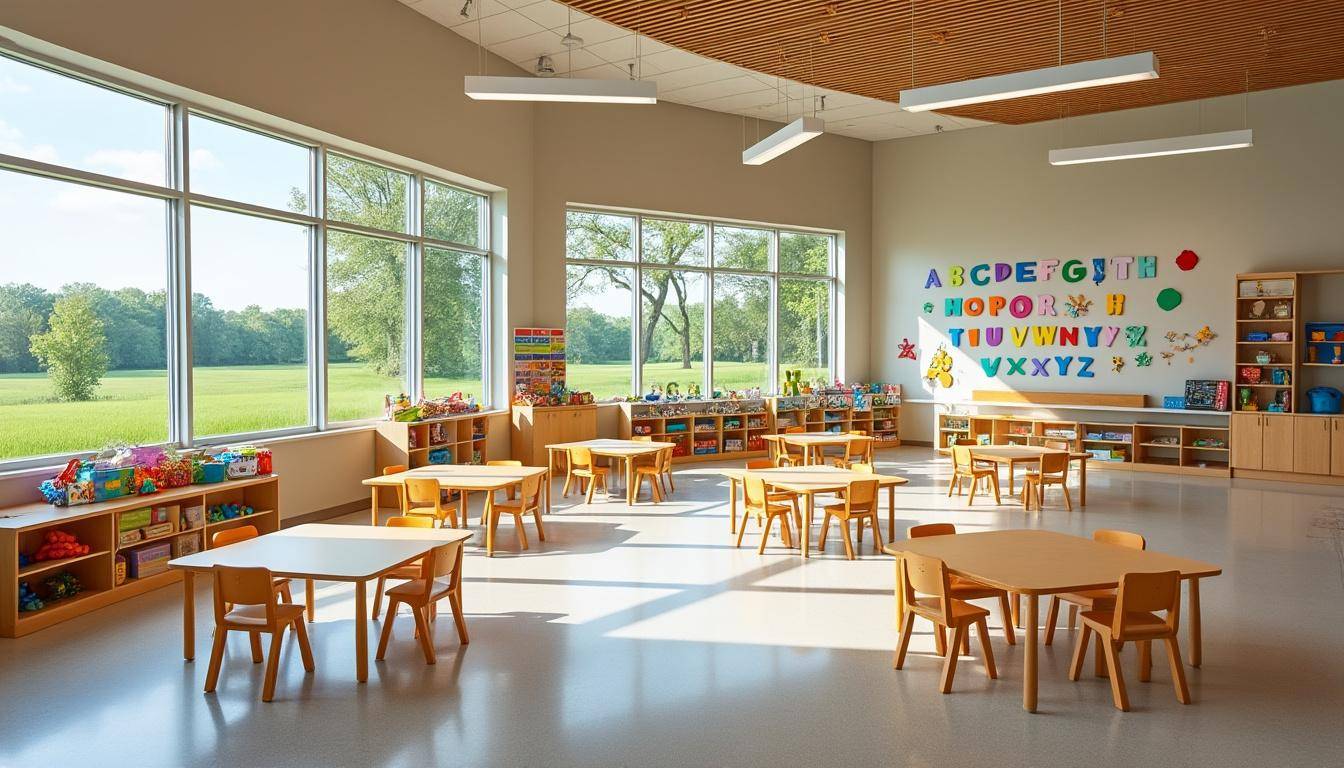
A new Child Care Center in rural Indiana opened with high expectations and a price tag of more than four million dollars. Classrooms, toys, and playgrounds are ready, yet most of the facility remains an empty facility. Families in Jay County need support, but deep funding issues and policy changes block access to childcare for the children who live nearby.
Inside the $4 Million Child Care Center in Rural Indiana
The Jay County Early Learning Center sits in a renovated former elementary school. The project represents a million dollar investment pulled together by the Portland Foundation, local donors, and state grants dedicated to early childhood education.
The Child Care Center includes rooms for infants, toddlers, and preschoolers. Shelves hold picture books, baby dolls, and puzzles. Large windows look out on a new playground where children are expected to run and explore.
On paper, the Child Care Center has capacity for around 160 children. In practice, about 30 are enrolled. This mismatch reveals deep operational barriers that affect not only this building in rural Indiana but the wider childcare system in the state.
How an early childhood education dream turned into an empty facility
The Portland Foundation and local partners started this project to address a clear problem. Jay County was known as a “child care desert,” with few licensed seats for the number of young children living there.
Local leaders argued access to childcare is essential for economic growth. Employers in agriculture and manufacturing struggle when parents stay home because they lack reliable care. Families lose income, and children miss high quality preschool experiences that prepare them for kindergarten.
Funders responded. Grants, including roughly three quarters of a million dollars from a state expansion program for quality providers, helped cover most renovation costs. The community believed this Child Care Center would become an anchor for rural development and school readiness.
Yet when the doors opened, state-level support for families had already shifted. The timing turned a celebrated project into a case study of how policy and practice diverge in early childhood education.
Funding Issues Behind an Empty Child Care Center
At the heart of the problem sit clear funding issues. The Jay County Child Care Center depends on tuition and public vouchers. Most local families earn below the state median income, and full tuition for an infant approaches two hundred dollars per week. Without help, many parents simply walk away.
During the pandemic, Indiana used federal relief dollars to expand Child Care Development Fund (CCDF) vouchers for low income working families. Those vouchers helped parents pay for licensed early childhood education instead of relying only on informal babysitting.
When temporary federal money expired, Indiana froze new CCDF enrollment. The freeze hit in late 2024, almost exactly when this Child Care Center opened. Families in Jay County who would have used vouchers were told no new slots were available.
Statewide childcare funding issues and economic loss
This story fits a bigger pattern. Reports from the U.S. Chamber of Commerce Foundation and Early Learning Indiana estimate the state loses more than four billion dollars each year because parents lack dependable child care. Lost earnings, reduced productivity, and lower tax revenue all stem from limited access to childcare.
When reimbursement rates for existing voucher users were trimmed again in 2025, providers across Indiana reported they needed to close classrooms or entire sites. Westminster Preschools, the nonprofit operating the Jay County site, even shut down another location to stay afloat.
The current plan signals no new vouchers until 2027. Without a new funding stream, Child Care Centers in rural Indiana carry high fixed costs with fewer paying families. The million dollar investment in buildings and equipment risks going underused while parents return to cheaper, unlicensed options at neighbors’ homes.
Other states face parallel pressures. For example, the crisis described in this analysis of the Texas child care crisis shows how fragile early learning systems become when public investment lags behind family needs.
Community Challenges Tied to Rural Development and Child Care
In Jay County, the community challenges linked to childcare go far beyond one building. The area depends heavily on agriculture and manufacturing. Work schedules start early, last long, and rarely match school hours.
When licensed Child Care Centers cannot serve enough children, parents piece together informal options. Some leave children with relatives who feel overwhelmed. Others use unlicensed babysitters who offer low rates but limited structure or learning activities.
This pattern affects school readiness. Teachers see children arrive in kindergarten with large gaps in vocabulary, self-regulation, and social skills compared with peers who attended structured preschool. Those gaps often persist through primary school without targeted support.
Local philanthropy and business response to access to childcare
The Portland Foundation refuses to let the empty facility stay idle. Leaders plan to create a local scholarship model to replace lost state support. Business partners who struggle to keep workers are encouraged to share costs so staff children receive seats at the center.
Such collaborations mirror efforts in other communities. For example, partnerships explored in this piece on nonprofit child care funding show how employers and charities pool resources to cover tuition gaps. Similar approaches help Boys & Girls Clubs extend hours and enrichment programs, as described in this look at Boys & Girls Club futures.
Yet philanthropy alone seldom replaces stable public funding. Leaders in Jay County understand scholarships will support some families but not all. They still call for state lawmakers to recognize early learning as core infrastructure, not an optional add-on.
The key insight here is simple. Rural development strategies that ignore access to childcare leave employers short-handed and children behind.
Operational Barriers Inside the Rural Indiana Child Care Center
Beyond funding, internal operational barriers shape daily reality. Staff recruitment and retention in rural Indiana already pose a challenge for schools and healthcare. Child Care Centers experience the same issue.
New laws in 2024 and 2025 lowered age requirements for workers and raised the number of children per caregiver. Lawmakers argue fewer rules will bring down prices. Advocates worry about safety and quality, especially for infants and toddlers who need close attention.
The Jay County center is licensed at higher quality standards and aims to keep small group sizes. That choice protects children but increases labor costs. When enrollment stays low because families cannot pay, every decision about staffing turns risky.
Daily realities for families balancing work and care
Consider a typical parent in Jay County working in a manufacturing plant. Shifts start at 6 a.m., yet the Child Care Center opens later. Transportation options are limited, and extended family might live far away.
Without vouchers, this parent faces a tradeoff. Pay high tuition and keep the job, or rely on a neighbor who charges less but offers only babysitting with little focus on early childhood education. Over time, repeated decisions like this shape children’s development and local labor supply.
Similar dilemmas appear in urban and international settings. Articles such as how caregivers engage kids in tough topics like race and Caribbean children’s mental health highlight how stress, instability, and exposure to screens instead of responsive adults affect growth.
Stable, affordable Child Care Centers reduce those pressures by giving children predictable routines and active learning experiences.
Early Childhood Education Quality in a Million Dollar Investment
The Jay County facility reflects best practices in early childhood education. Learning zones are arranged for hands-on play. Teachers use picture books, pretend kitchens, and building blocks to support language, numeracy, and social skills.
High quality preschool programs share common elements. They employ trained educators, follow research-based curricula, and maintain consistent relationships between children and caregivers. Such environments prepare children for reading instruction, math concepts, and classroom routines.
When a four million dollar Child Care Center remains half empty, the loss goes beyond wasted space. Children who attend informal care rarely receive the same intentional learning experiences. Over time, this gap contributes to lower achievement and even reduced earnings in adulthood.
Equity, inclusion, and long-term impact
Access to strong early learning matters even more for children facing poverty or discrimination. Research across the United States shows that inclusive Child Care Centers narrow early gaps and support social mobility.
Discussions like those in this piece on empowering Black children in education underline how early settings shape identity and opportunity. When funding policies limit access in places such as Jay County, the impact falls hardest on families with the fewest resources.
Local leaders who support the rural Indiana Child Care Center often describe the building as an investment in the next generation of workers and citizens. If the facility serves a fraction of its potential enrollment, the community sacrifices both academic and economic gains.
Effective early childhood education transforms a building from an empty facility into a daily engine for learning and inclusion.
Lessons for Rural Development and Child Care Policy
The story of the four million dollar Child Care Center in Jay County offers lessons for other communities. Rural leaders who plan new centers need realistic assumptions about families’ ability to pay and long-term public support.
They also need to think about transportation, work schedules, and communication. Parents must see the value of licensed care over cheaper, informal arrangements, especially when wages stagnate and costs rise.
Several education partnerships show how broader coalitions support children and families. For instance, this example of university-school collaboration for education illustrates how higher education partners strengthen local programming. Projects described in Norfolk parents’ education support highlight the role of parent training and information in strengthening home learning.
Key steps communities take to avoid another empty facility
Communities that want to avoid the same outcome often follow a few structured steps before opening a Child Care Center. These steps connect funding, design, and family voice.
- Conduct a true needs assessment: Map working parents’ schedules, income levels, and existing informal care to see who will enroll and at what price.
- Secure layered funding: Mix public vouchers, employer contributions, philanthropy, and sliding-scale fees so no single source decides survival.
- Align hours with work patterns: Adjust opening and closing times to match local employment in agriculture, manufacturing, health, or service sectors.
- Invest in staff pipelines: Partner with high schools, community colleges, and universities to train and retain educators in early childhood education.
- Engage parents early: Offer open houses, parenting workshops, and trial days so families trust the center long before full enrollment targets.
These actions reduce operational barriers and help a Child Care Center become a core piece of rural development instead of a silent building.
Children, Families, and the Future of the Rural Indiana Child Care Center
Behind the policy debates about vouchers and deregulation stand infants, toddlers, and preschoolers whose first learning experiences shape their futures. Each empty seat in the Jay County Child Care Center represents a child who spends the day elsewhere, often in front of a television rather than in a rich learning environment.
National conversations about work, technology, and education recognize the importance of early learning. Stories about corporate-led initiatives, such as those mentioned in analyses of Elon Musk and childcare discussions, show how employers explore on-site care or subsidies for staff parents. Yet rural communities without large corporations depend much more on state policy and local philanthropy.
Resources that support diverse learners, such as tools for sensory-rich learning experiences for visually impaired students described in this overview of sensory learning tools, remind us that inclusion begins early. A well-run Child Care Center in rural Indiana offers a place where every child, regardless of need or background, starts school on stronger footing.
The million dollar investment in Jay County shows what happens when high quality early childhood education collides with funding cuts and policy shifts. Whether this empty facility fills with children or remains underused will depend on choices made by lawmakers, employers, philanthropies, and families in the coming years.