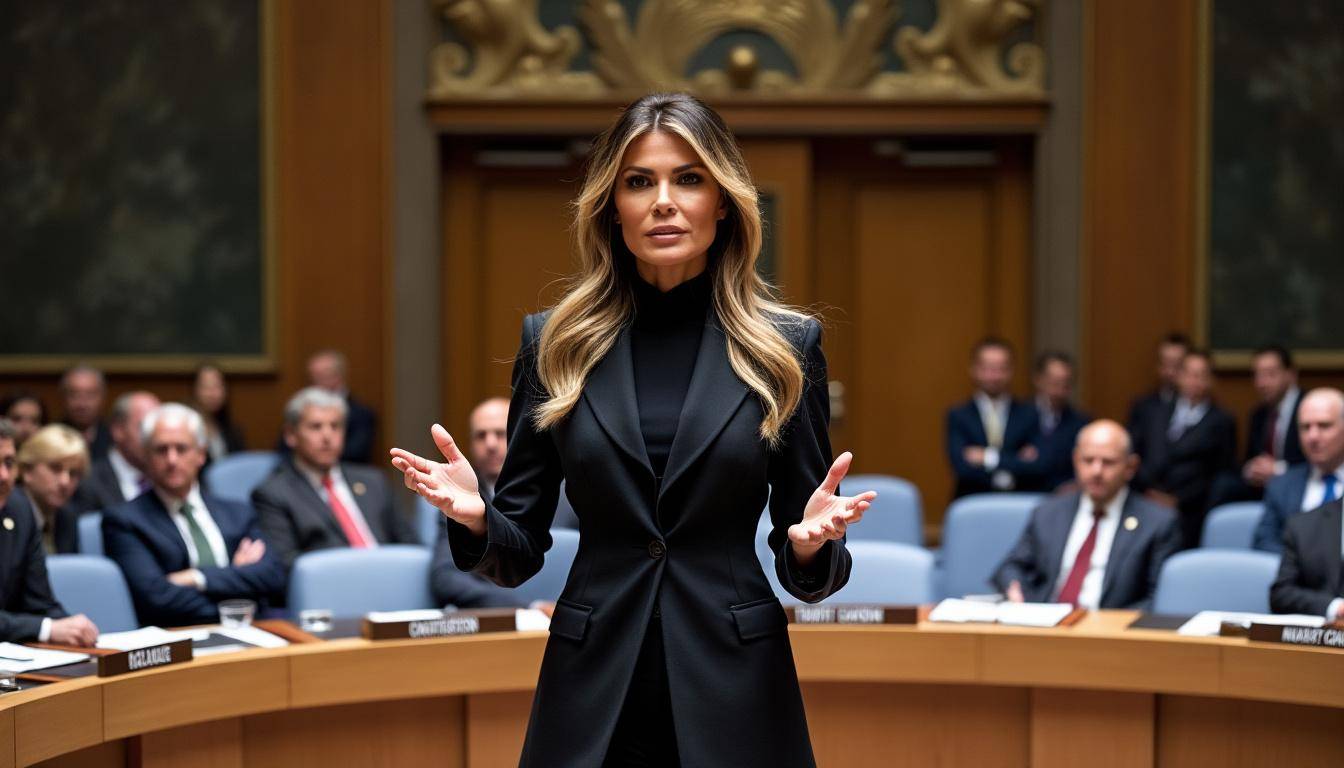
Melania Trump used the UN Security Council to focus attention on protecting children in conflict zones, linking education, child welfare and international security. Her leadership in this session highlighted how war reshapes classrooms, families and future societies.
Melania Trump and the UN Security Council on Protecting Children
At a high-level meeting in New York, Melania Trump presided over a UN Security Council debate on protecting children and securing education in conflict zones. It marked the first time a leader’s spouse chaired such a session, which drew global attention to child protection as a core issue of international security.
In her address, she stressed that schools give children stability, hope and a pathway to peace. She linked classrooms to long-term human rights progress, arguing that every attack on a school is an attack on a community’s future. This message came during ongoing military operations in the Middle East, which amplified the political weight of her words.
Global challenges and education in conflict zones
UN officials at the meeting underlined how global challenges such as regional wars, forced displacement and cyber disruption now intersect inside classrooms. When bombing begins, children are often the first to lose safety, routine and access to learning.
The UN noted recent school closures across Israel, the United Arab Emirates, Qatar, Bahrain and Oman because of ongoing operations. Many students shifted overnight to remote learning, but the poorest families often lack devices or connectivity. This turns a security crisis into an education crisis and then into a long-term inequality problem.
This pattern is not new. From Syria to Ukraine, long conflicts have shown how years without quality schooling increase risks of early marriage, recruitment by armed groups and cycles of poverty. The Council session with Melania Trump highlighted how these trends now overlap and accelerate.
War, child welfare and international security
The meeting linked child welfare directly to international security. When children in conflict zones lose education and protection, societies face higher levels of violence for decades. The cost shows up later through unstable labor markets, radicalization and weak institutions.
UN data over the last years point to thousands of verified attacks on schools and hospitals worldwide. Each incident is more than a number. Behind every school hit stands a network of teachers, parents and local leaders who lose a central pillar of community life.
Controversy and accountability in child protection
The timing of the session sparked criticism. Iran’s ambassador accused the United States of hypocrisy for convening a debate on protecting children while facing accusations about a deadly strike on an elementary school in Minab. Iranian officials reported more than one hundred deaths and placed blame on the US and Israel.
US Central Command announced an investigation, and Israel’s military said it was not aware of operations in the area. US Secretary of State Marco Rubio stated that the United States does not deliberately target schools. These conflicting narratives show why child protection in war zones sits at the heart of debates on accountability and human rights.
For families on the ground, legal arguments feel abstract. Parents want transparent investigations, reparations when harm occurs, and firm guarantees that classrooms will stay out of the line of fire in future operations.
Protecting children in conflict zones through education
Speakers at the UN Security Council agreed on a core principle. Protecting children in conflict zones means more than keeping them physically safe. It means defending their right to learn, grow and rebuild.
Education experts describe schools as “protective spaces” where children receive not only lessons but meals, mental health support and social contact. When these hubs disappear, rates of trauma symptoms and long-term health problems rise sharply.
Key strategies for child protection in war settings
To turn global concern into action, humanitarian groups, educators and governments use a combination of approaches. You see these tools in refugee camps, occupied cities and fragile rural regions.
- Safe school zones: Agreements with armed actors to recognize schools and surrounding areas as no-strike sites.
- Temporary learning spaces: Tents, community halls or containers converted into classrooms when buildings are damaged.
- Teacher training: Rapid training on trauma-aware teaching and crisis management.
- Psycho-social support: On-site counselors, peer-support groups and structured play sessions.
- Remote and radio learning: Printed materials, radio programs and offline digital tools where internet access is limited.
Each method aims to protect not only the right to education but wider child welfare, including emotional stability and a sense of normal life.
Families like those in the fictional town of “Alma” near a contested border often use multiple strategies at once. Parents send children to a local tent school in the morning and rely on radio lessons in the evening when security conditions change.
Human rights, peacekeeping and long-term stability
The Security Council debate led by Melania Trump also tied human rights principles to modern peacekeeping practice. Traditional missions focused on separating armed groups. Today, missions in Africa and the Middle East include mandates to monitor violations against children, support education ministries and help rebuild school systems.
Peacekeepers now work with child protection advisers who document recruitment of minors, sexual violence and attacks on schools. Their reports inform sanctions, court cases and public naming of offending groups. This monitoring creates pressure for behavioral change and signals that crimes against children carry consequences.
Child protection as a peacekeeping priority
Integrating child protection into peacekeeping changes daily routines. Patrols prioritize routes near schools and markets at arrival and dismissal times. Mission planners work with local educators to design early warning systems, such as text alerts or community messengers for nearby threats.
Some missions support accelerated learning programs for adolescents who lost years of schooling during conflict. Without such options, these youths face higher risks of recruitment by armed groups or criminal networks. Education here functions as a stabilizer that reduces incentives for violence.
This shift reflects a broader understanding within international security. Protecting children in conflict zones is not a side issue. It sits near the center of any credible peace strategy.
When you treat child welfare as strategic, not symbolic, peace operations gain public trust. Communities start to view blue helmets not only as soldiers but as partners in rebuilding schools and futures.
Global challenges for children beyond active war zones
Protecting children amid global challenges means looking beyond front-line fighting. Fear, displacement and policy decisions in safer countries also shape childhood and schooling. Families who flee conflict often face years of uncertainty in host states.
Research on immigrant students in US schools shows both resilience and strain. For example, documented experiences in Minnesota highlight how immigrant families balance hope for education with anxiety about legal status and cultural adaptation. Stories similar to those described for families in Minnesota in resources such as this case study on immigrant families and school integration show how much support children need even after they leave conflict zones.
Fear, rights and access to education
Security policies in peaceful countries can still affect child welfare. In parts of the United States, for example, children from undocumented families have skipped school because they fear immigration enforcement on the way to class. Reports from Connecticut and other states, similar to those discussed in analyses of school attendance and immigration fears, show attendance drops when raids or arrests rise.
These situations are not war, but children experience them as chronic stress. When fear follows them to school corridors, concentration suffers, and academic performance falls. Protecting children in a broad sense means designing safety and immigration policies that respect human rights while still addressing security concerns.
Viewing this through the lens of the Security Council, you see a continuum. From front-line conflict zones to host communities thousands of kilometers away, decisions about security directly influence classroom doors opening or closing.
Practical steps for parents and educators in times of crisis
While debates at the UN Security Council shape international norms, parents and educators work at the frontline of child protection each day. Even far from conflict zones, global crises, online violence and news of war impact children’s sense of safety.
Consider “Sara,” a 10-year-old who watches footage of distant bombings on her phone. She lives in a peaceful country but has classmates whose relatives are caught in conflict. Teachers and parents around her face a clear question. How do you support children exposed to constant images of suffering and fear?
Everyday practices to strengthen child welfare
There are concrete steps you can take to protect children’s emotional and educational well-being in this context.
- Open conversations: Talk honestly about news without graphic details. Invite questions and admit when you need to look up more information.
- Limit exposure: Set boundaries for news and social media intake, especially before bedtime or exams.
- Connect to action: Involve children in age-appropriate solidarity activities such as writing letters, joining school projects or supporting charities that work on child welfare.
- Watch for signs of distress: Look for sleep problems, withdrawal or sudden drops in school performance.
- Engage the school: Ask how teachers address global conflicts in class and advocate for inclusive, factual and respectful discussion.
These practices do not replace international agreements, but they help children process crises in ways that protect their mental health and engagement with learning.
When homes and schools become places where emotions are recognized and handled with care, children build resilience that supports both personal growth and social stability.
Why protecting children in conflict zones matters for the future
The UN Security Council session led by Melania Trump highlighted a simple but demanding truth. Protecting children in conflict zones is not only a moral duty. It is a long-term strategy for global peace and security.
When children keep learning, even in emergencies, societies preserve skills, trust and hope. When their schools are defended, futures stay open. By linking child protection, peacekeeping and human rights, global leaders, parents and educators work on the same project. They safeguard the next generation’s chance to live without war as a daily lesson.