

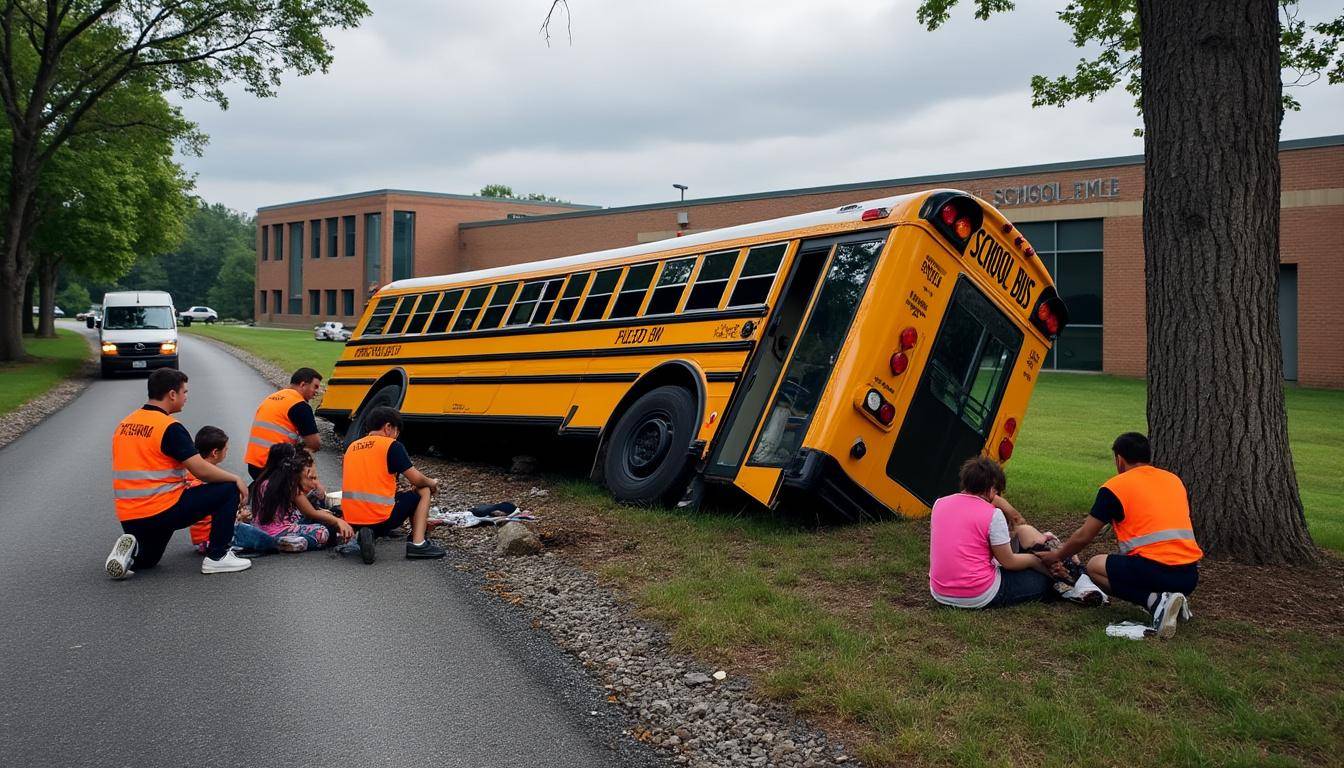
A tragic Tennessee school bus accident during a field trip left two students dead and several others with serious injuries. The crash involved a Kenwood Middle School bus, a state dump truck and an SUV, and it triggered a regionwide emergency response.
Tragic Tennessee school bus accident: what happened
On March 27, a tragic school bus accident in Tennessee involved a Clarksville-Montgomery County School System bus carrying 25 students and five staff members. The group was traveling along Highway 70 in Carroll County around midday.
The school bus was headed to a student engineering competition in Jackson when the crash occurred. A Tennessee Department of Transportation dump truck and a Chevrolet Trailblazer were also involved, which increased the violence of the impact and the number of injuries.
Two middle school students suffered fatal injuries, and several others were transported to hospitals. As of the following morning, details on individual conditions and the exact sequence of events remained under active review by authorities.
Field trip turned tragic for Tennessee students
The Tennessee school bus accident struck a group of young people who had spent months preparing for the Greenpower USA Toyota Hub City Grand Prix. Students had built electric race cars and were traveling to compete and represent their school community.
Kenwood Middle School principal Karen Miller described the day as an “unimaginable tragedy.” Families expected a day of learning and celebration. Instead, they faced sudden loss, medical crises and deep shock.
This contrast between an educational trip and a deadly crash underlines how quickly a routine school event can shift into a life-changing moment for an entire district.
Emergency response to the Tennessee school bus crash
The emergency response to the Tennessee school bus accident involved multiple agencies from across the region. Local law enforcement, Tennessee Highway Patrol, fire departments, EMS crews and air medical teams coordinated on scene.
Officials reported that seven air ambulances transported the most seriously injured students and adults to different hospitals. Ground ambulances carried others to nearby facilities for evaluation and treatment.
A local church in Huntingdon served as a reunification center where families met their children and received updates. This rapid setup helped reduce confusion and gave parents a clear place to go in a chaotic situation.
How emergency response shapes outcomes after a school bus accident
In a fatal school bus crash, the speed and coordination of emergency response influence survival and long-term outcomes. Early triage, quick airlift decisions and clear communication between hospitals support better care for injured children.
In Carroll County, the decision to send multiple helicopters showed how seriously first responders treated the scene. Children with head trauma, internal bleeding or complex fractures need specialized pediatric care that smaller hospitals do not always provide.
For parents and schools, this event highlights the need to know local emergency response plans, regional trauma centers and how reunification sites operate in a crisis.
Investigation into the Tennessee school bus crash
The Tennessee Highway Patrol opened a formal investigation into the school bus accident to understand what led to the fatalities and severe injuries. Investigators review vehicle positions, skid marks, damage patterns and road conditions.
They also analyze driver statements, electronic data recorders, maintenance logs and weather reports. The involvement of a dump truck and SUV adds complexity, since each vehicle introduces its own speed, weight and braking behavior.
Officials ask the public to avoid speculation while the investigation continues. Premature blame distracts from facts and adds emotional strain on families and staff already in grief.
Why investigation after a fatal school bus accident matters for schools
Every tragic school bus crash offers hard lessons that protect future students. Investigations often lead to changes in driver training, routing, vehicle inspections or collaboration with highway departments.
After a serious school bus accident in South Africa, for example, authorities reviewed road design, seatbelt rules and supervision ratios. Tennessee education leaders will likely follow a similar path once final findings emerge.
For districts, a transparent investigation also supports trust. Families want clear answers on whether the crash stemmed from mechanical failure, human error, road hazards or a combination of factors.
Community grief and support after Tennessee school bus fatalities
In the days after the tragic school bus accident, community leaders in Clarksville and across Tennessee expressed deep sorrow. The governor called for prayer and thanked first responders. City and county officials emphasized unity and compassion over blame.
The school district highlighted its “shattered hearts” at the loss of two young lives. Staff prepared to support surviving students, injured adults and families of the children who died.
Community members organized vigils, meal trains and fundraisers. These acts provide immediate relief, but they also send an important message to children: they are not facing this trauma alone.
How parents support children after a tragic school bus crash
Many children first hear about a school bus accident through social media or school rumors. Kenwood Middle School leaders urged families to choose the timing and language they use at home to discuss the fatalities and injuries.
School counselors recommended that parents look for signs such as sleep trouble, avoidance of buses, jumpiness near traffic or strong fears about future field trips. These reactions are common after a high-profile crash.
If your child struggles, brief and regular conversations help more than one long talk. You might say, “You are safe right now. Adults at school and in our community work hard to protect you. It is okay to feel sad or scared, and you can tell me anytime.”
- Listen without interruption when your child describes fears or questions.
- Stick to simple, honest facts about the Tennessee school bus accident.
- Limit graphic media exposure, especially videos shared by peers.
- Keep predictable routines at home to restore a sense of safety.
- Reach out to school counselors if worries or avoidance last more than a few weeks.
These steps help children process tragedy in a way that honors their feelings while rebuilding trust in daily life.
School counseling and long-term recovery after a school bus accident
Kenwood Middle School and the district prepared counseling services for as long as needed. The principal stressed that the wellbeing of students, staff and families will stay the top priority long after the news cycle ends.
In the first weeks, school counseling teams focus on crisis support, group sessions and classroom check-ins. Over time, they shift toward individual therapy referrals, behavior monitoring and accommodation plans for students whose learning was affected by trauma.
Research on post-traumatic stress in youth shows that some children appear fine at first but struggle later with concentration, irritability or academic decline. Maintaining support months after a tragic crash helps catch these delayed effects.
What schools learn from each tragic school bus accident
Every serious school bus accident in Tennessee or elsewhere pushes schools to review field trip policies. Teams review supervision ratios, route selection, pre-trip briefings and communication plans.
Districts also study other youth safety issues to strengthen their approach. For instance, resources on youth vehicle safety show similar patterns of risk: distractions, speed, road design and uneven training for adult supervisors.
When leaders treat a single tragedy as a catalyst for systemwide reflection, the long-term result is fewer fatalities and injuries in future school activities.
Safety lessons for parents and educators from the Tennessee bus crash
This tragic Tennessee school bus accident raises hard questions for every parent and educator about everyday school travel. While no trip is risk free, several practical steps improve safety for students.
These lessons apply whether your child rides a bus daily, attends occasional field trips or studies in alternative settings such as home education.
Practical steps to reduce risk during school transport
First, know your district’s school bus safety standards. Ask how often buses receive inspections, what training drivers complete, and how routes are chosen for trips on high-speed roads.
Second, talk with your child about bus behavior: staying seated, keeping aisles clear, listening to the driver and reporting unsafe driving or bullying. These small habits reduce distractions at critical moments.
Third, review how your family handles other risk situations. Insights from topics such as home-schooled students and hidden struggles or digital safety around learning games show that safety is always multi-layered: environment, adult oversight and student habits all interact.
When adults treat transport safety as part of everyday education, children learn to recognize danger, respect rules and speak up early about concerns.