

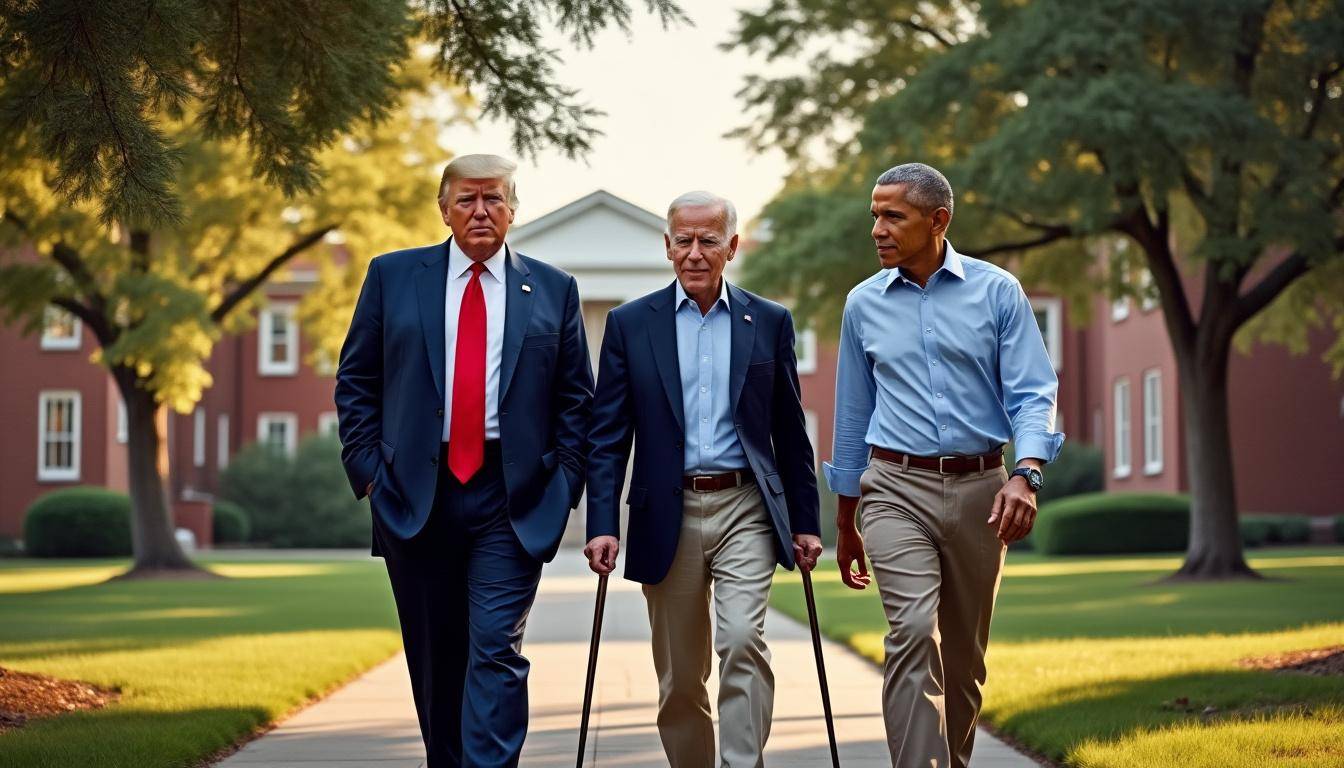
Trump’s mockery of Biden and Obama and how they walk tells you more about leadership, values and education in public life than about their steps on a staircase.
Trump mocks Biden and Obama’s walks: why this Trump behavior matters
When Trump mocks Biden and Obama for how they walk, he turns a simple physical act into a public test of strength and worth. At a Kentucky rally, he described edging down wet stairs slowly, then contrasted himself with Obama’s walk, calling Obama’s careful “bob” down the stairs “unpresidential.”
He then moved to Biden’s walk, replaying Biden’s past falls and insisting “the world watches that and they don’t like seeing it.” In his story, a leader’s value gets tied to how they stay on their feet. This Trump behavior is not new. He often uses a rival’s body language, movement and physical traits to question their fitness for office.
Body language, Trump, and the politics of the walk
Trump treats body language as direct proof of character. In his framing, a slow or shaky walk signals weakness. An easy stride signals strength. You hear this every time he highlights stairs, ramps or slips.
This is risky logic. People age. People trip. People live with disabilities. None of this tells you how well they govern. By turning every Biden walk or Obama walk into a punchline, Trump narrows the idea of leadership to a narrow, “perfect body or nothing” standard. This affects how audiences judge any public figure who moves differently.
Tom, a fictional civics teacher in Ohio, uses these rally clips in class. He pauses when Trump mocks Biden’s walk and asks his students: “What do you learn here about policy?” The room goes quiet, and students notice the gap between surface performance and real issues. That silence becomes a lesson on how public perception gets shaped by small, repeated jabs.
How mockery of walks feeds ableism and ageism in politics
Experts in disability studies describe this pattern as a form of ableism and age-based bias. Trump links physical stability with overall competence. When he mocks how Biden walks or how Obama moves, the message is clear: if your body shows any limitation, your whole ability is suspect.
Douglas Kruse from Rutgers has noted that such comments often reflect both fear of aging and a need to prove “I am still able.” In an aging political class, that pressure is strong. Many older leaders feel pushed to perform youth through posture, pace and movement.
From Trump mocking Biden and Obama to everyday ableist behavior
Davey Shlasko, who works on inclusion training, explains a common assumption behind remarks about a walk or a fall. People assume one impairment equals full incompetence. If you need a ramp, they talk to you slowly. If you use a wheelchair, they talk over you. If you stumble, your judgment gets questioned.
Trump’s rally lines tap straight into this. The laugh at Biden’s walk or Obama’s careful steps signals to the crowd that strength and worth sit in the legs. This is not limited to one politician. The same pattern appears in offices, schools and families when a person’s physical difference gets used to question intelligence or value.
For parents and educators, this raises a key question. What do children learn when they see national leaders mock how others walk instead of engaging their ideas? If you want a different norm, you need to name ableism early and offer alternatives. Resources like this guide on nurturing kindness in children help families build a language of respect before mockery becomes a habit.
When mocking walks spreads across the political field
Ableist thinking does not stop with Trump. At the same Kentucky rally, he attacked Gavin Newsom’s dyslexia, saying he had “mental problems” and a “cognitive deficiency.” Here again, Trump uses a specific learning difference to question overall fitness to lead.
Dyslexia affects reading and writing, not general intelligence. Many leaders, entrepreneurs and scholars live with dyslexia and thrive. When Trump ties dyslexia to “deficiency,” he sends a message to every student with a learning difference: your diagnosis makes you unfit to be trusted.
When responses to Trump repeat the same ableist pattern
Opponents often answer Trump with the same tool he uses. After his dyslexia remarks, Newsom fired back by calling Trump a “brain-dead moron.” The insult hit Trump, but it also leaned on outdated language used to label people with intellectual disabilities.
This is how ableism circulates. One side mocks a walk, a fall, a reading difference. The other side mocks intelligence, cognitive decline or body shape. The target shifts, but the hidden rule stays: people whose bodies or minds fall outside a narrow norm are less worthy.
Rep. Ilhan Omar offers a different path. In 2020, she first mocked Trump’s own trouble with stairs, then deleted the post and wrote that his racism and authoritarian style were enough reasons to oppose him. She named his physical abilities as the wrong target. That move models how to shift critique from body language to behavior and policy.
Public perception, character, and what Trump’s focus on walks reveals
Through repeated jokes about how Biden walks or how Obama takes stairs, Trump builds a story about character. In this story, bodies are billboards. If a leader moves with ease, they are strong. If they slip or stiffen, they are weak.
But public perception of character is also shaped by what a leader chooses to talk about. When Trump spends time on walks instead of wages, on falls instead of foreign policy, it signals priorities. Students in Tom’s class pick up on this. They ask why a president speaks more about steps than about disabled veterans’ access to services.
Behavior over body language: what to teach young citizens
For younger audiences, it helps to separate three layers:
- Body language: how a person looks and moves in public.
- Behavior: how a person speaks, treats others and responds to criticism.
- Policy impact: how their decisions affect people’s daily lives.
Trump’s jokes about Biden’s walk sit in the first layer. His repeated insults and the culture they foster sit in the second. His administration’s record on disability services sits in the third. When you teach students to rank these layers, they start to see that a shaky step means less for democracy than a budget cut.
This shift matters for how they judge any future leader, not only Trump, Biden or Obama. The lesson is simple: watch behavior and policy more than posture.
From mocking walks to real-world consequences for people with disabilities
Language around walks and falls does not stay at the level of jokes. It prepares the ground for decisions. During Trump’s time in office, disability groups tracked several moves that hurt people with disabilities. Layoffs from shutdowns hit disabled workers heavily. Protections that limited discrimination in hiring were rolled back.
His team also cut the special education office at the U.S. Department of Education. Over 7 million children use those services. When that support shrinks, classroom aides vanish, evaluations are delayed, and families wait longer for the help their children need.
Teaching students to connect rhetoric, walks, and policy
Tom often ends his lesson on Trump mocking Biden and Obama’s walks with a simple exercise. He writes three questions on the board:
- What did the speaker mock or praise?
- Who benefits from this kind of talk?
- What policies match or contradict this message?
Students apply these questions to the stair comments, the dyslexia insult and the broader record on disabled citizens. They notice that praising “strong” bodies does not align with cutting programs that help those same bodies live and learn.
Families can do something similar at home. When a child laughs at a joke about someone’s walk, parents can ask, “How would you feel if someone judged you only by how you move?” Discussions like these, supported by resources from sites such as Education to the Top, turn passive viewers into thoughtful readers of public behavior.