

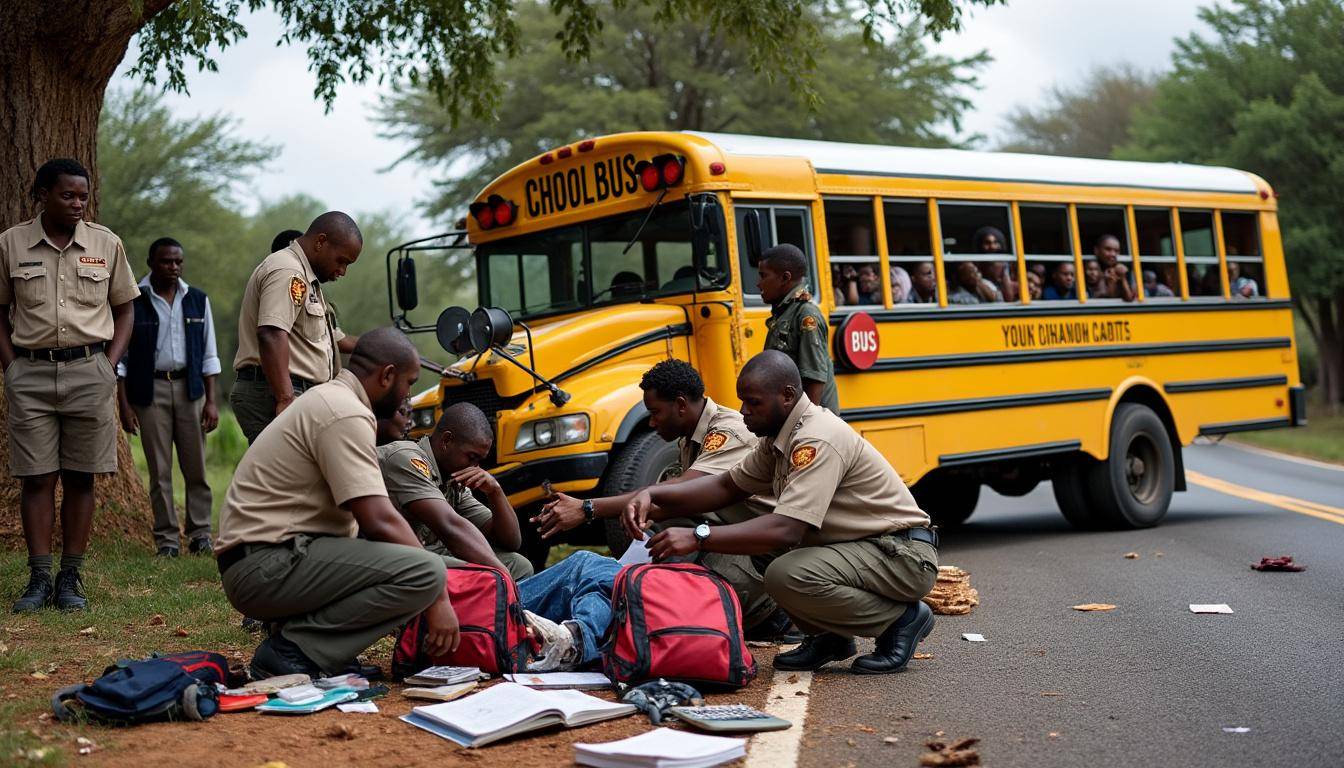
A tragic school bus accident in South Africa has left families and schools in deep shock. Authorities confirm at least 13 children lost their lives after a collision between a minibus and a truck in Gauteng province, with several other students and the driver injured.
Tragic school bus accident in South Africa: what happened
According to authorities, the tragic school bus crash took place early in the morning, around 7 a.m., in the southwest of Johannesburg. A private minibus was taking learners to different primary and high schools when it collided head-on with a truck.
Witnesses report the minibus was overtaking stationary vehicles before the impact. The collision led to multiple fatalities at the scene, with 11 children dying immediately and two more passing away later in hospital. The bus driver suffered injuries and was taken to hospital with other students.
Parents arrived to find school bags, books and stationery scattered on the road while emergency teams worked. For many families, the school run turned into an event they will never forget, with their daily routine suddenly shattered by this tragic accident.
Authorities, investigation and early findings on the crash
The provincial education department and traffic authorities opened an investigation into the crash. Police confirmed the truck driver will be questioned, and road conditions and vehicle status will be checked in detail.
Provincial education minister Matome Chiloane explained that the behaviour of the school bus driver is under review for possible reckless driving. Investigators focus on speed, overtaking decisions, and whether the minibus respected traffic rules before the impact.
At national level, President Cyril Ramaphosa expressed deep sadness and insisted that every stakeholder must respect road rules when transporting learners. His message highlights a long‑standing concern: road safety in South Africa already ranks among the worst worldwide, and each new tragedy raises the same urgent questions.
Emergency response and support for affected families
The emergency response started within minutes. Gauteng Emergency Services took five injured students to Sebokeng Hospital and two to Kopanong Hospital. The driver of the minibus went to hospital as well, under observation for his injuries and for future questioning.
At the scene, paramedics, firefighters, and police worked together. Some secured traffic and assessed the damaged vehicles. Others focused on stabilising the injured children and providing emotional support to shocked witnesses and parents.
National and provincial teams also activated psychosocial support. Counsellors and school psychologists visited affected schools to talk with surviving classmates and teachers, helping them process grief and fear after such a traumatic accident.
Psychosocial care in the wake of a school bus tragedy
Young learners often struggle to understand why classmates do not return to class. After a tragic school bus accident in South Africa, learners might develop sleep problems, fear of transport, or difficulty concentrating in lessons.
Experienced school counsellors often recommend small group discussions, memory activities, and structured routines to rebuild a sense of safety. Teachers receive guidance on how to answer children’s questions honestly without feeding anxiety.
Parents also need support. Many report guilt for having placed their child in a particular vehicle or route. Trained psychologists help them distinguish real responsibility from emotional shock, and guide them to support surviving siblings in a balanced way.
School bus safety in South Africa: systemic issues and risks
This tragic event once again highlights chronic weaknesses in school bus safety in South Africa. Many learners rely on private minibuses instead of formal state buses, especially in townships and peri‑urban areas. These vehicles often operate under tight financial pressure.
In some areas, parents choose cheaper providers who use older vehicles or drive more trips each morning to increase income. This raises the risk of speeding, unsafe overtaking, and overloading, all of which increase the chance of a fatal crash.
The minister of basic education, Siviwe Gwarube, pointed to driver error as a frequent cause of school transport accidents. She also urged the Department of Transport to ensure every vehicle that carries children is roadworthy and properly inspected.
Key risk factors in school transport and what parents should watch
If you are a parent, you often depend on others to get your child to school. Yet you still hold strong influence on safety through your choices and questions. Some of the most common risk factors in school transport include:
- Driver behaviour: speeding, aggressive overtaking, cell phone use while driving.
- Vehicle condition: worn tyres, faulty brakes, broken seat belts, overcrowded seats.
- Route design: unsafe intersections, poor visibility, lack of pedestrian crossings near schools.
- Time pressure: tight schedules that push drivers to rush multiple trips every morning.
- Lack of supervision: no adult assistant to manage children and help with safe boarding.
Each of these elements increases the risk of another tragic school bus accident. Parents, schools, and transport providers need to treat these warning signs as non‑negotiable issues.
What parents and schools should demand after a fatal school bus crash
After such a tragic accident in South Africa, many parents ask what they should do differently. Stronger regulation matters, but daily decisions at school and family level also shape risk levels for children.
One practical step is to establish formal agreements between schools and transport operators. These agreements can define maximum passenger numbers, required licences, regular vehicle checks, and procedures for complaints from parents or staff.
School governing bodies and parents’ associations can also conduct periodic unannounced checks at pick‑up points. When drivers know they face real oversight, reckless behaviour tends to drop significantly.
Concrete safety questions every parent should ask
Before you entrust your child to any school bus or minibus service, ask direct, practical questions. You do not need technical expertise. Clear questions alone help filter unsafe providers.
Key questions include:
- Do you hold a valid professional driver’s permit and proof of insurance for transporting children?
- How often is this vehicle inspected, and who performs the service?
- How many learners do you transport per trip, and do all seats have usable seat belts?
- What is your plan if the vehicle breaks down or an accident happens?
- Are you willing to let parents inspect the vehicle inside and outside?
Responsible drivers answer these questions calmly and provide documents. Evasive replies signal risk and justify seeking safer alternatives.
Learning from other child safety contexts
Discussions about a tragic school bus accident in South Africa connect with wider debates on youth safety and mobility. From road transport to entertainment, each context brings specific risks and opportunities for learning.
For example, analysis of youth golf cart safety shows how informal vehicles used in estates and campuses often lack seat belts and proper supervision. The patterns mirror school transport challenges: mixed traffic, distracted drivers, and pressure to move groups of children quickly.
Another area relates to home environment and mental load. The article on hidden struggles among home-schooled learners reminds us that safety is not only physical. Emotional security, predictable routines, and clear rules also protect children, whether they travel in a bus or learn at home.
Technology, learning, and safe habits
Digital tools influence how children think about risk and decision making. Studies on how video games enhance learning highlight links between interactive play and skills such as rapid attention shifts, strategic planning, and spatial awareness.
When adults guide children, certain games support conversations about road signs, safe crossing, and response in emergencies. Short simulation games that present traffic choices, for example, help learners rehearse decisions before they step out near a street.
Of course, technology does not replace adult role‑modelling. However, used purposefully, it strengthens the language and habits children bring with them when they board a school bus or walk near busy roads.
Building a culture of safety around school transport
After each tragic school bus accident, South Africa faces the same test: will society treat it as an isolated event or as a call to transform everyday practices around children’s transport. A culture of safety grows from repeated, visible actions.
In one Johannesburg township, for example, a fictional primary school named Sakhile Primary formed a safety committee that meets monthly. The committee includes two parents, two teachers, a learner representative, and one transport provider. Together they review complaints, check accident statistics, and propose small but concrete improvements, such as adjusting pick‑up points away from busy intersections.
Over time, such small changes reduce exposure to risk even when broader national reforms move slowly. Each school community that takes these steps contributes to fewer fatalities and fewer headlines about another tragic school transport crash.
Practical steps for schools to improve safety today
School leaders often feel powerless when a tragedy hits far from their own gates. Yet there are practical measures they can start this week to protect learners during every trip.
Here are key actions schools can implement:
- Map transport patterns: know which routes and vehicles your learners use, even when services are private.
- Create a transport code of conduct: define clear expectations for drivers, parents, and learners.
- Offer safety workshops: invite traffic officers to speak about road rules and emergency response.
- Introduce reporting channels: give learners and parents a simple way to report unsafe driving anonymously.
- Run safety drills: practise how staff respond if a school bus accident occurs near the campus.
When schools embed these practices into their culture, children learn that safety is part of daily life, not a topic raised only after a disaster.