

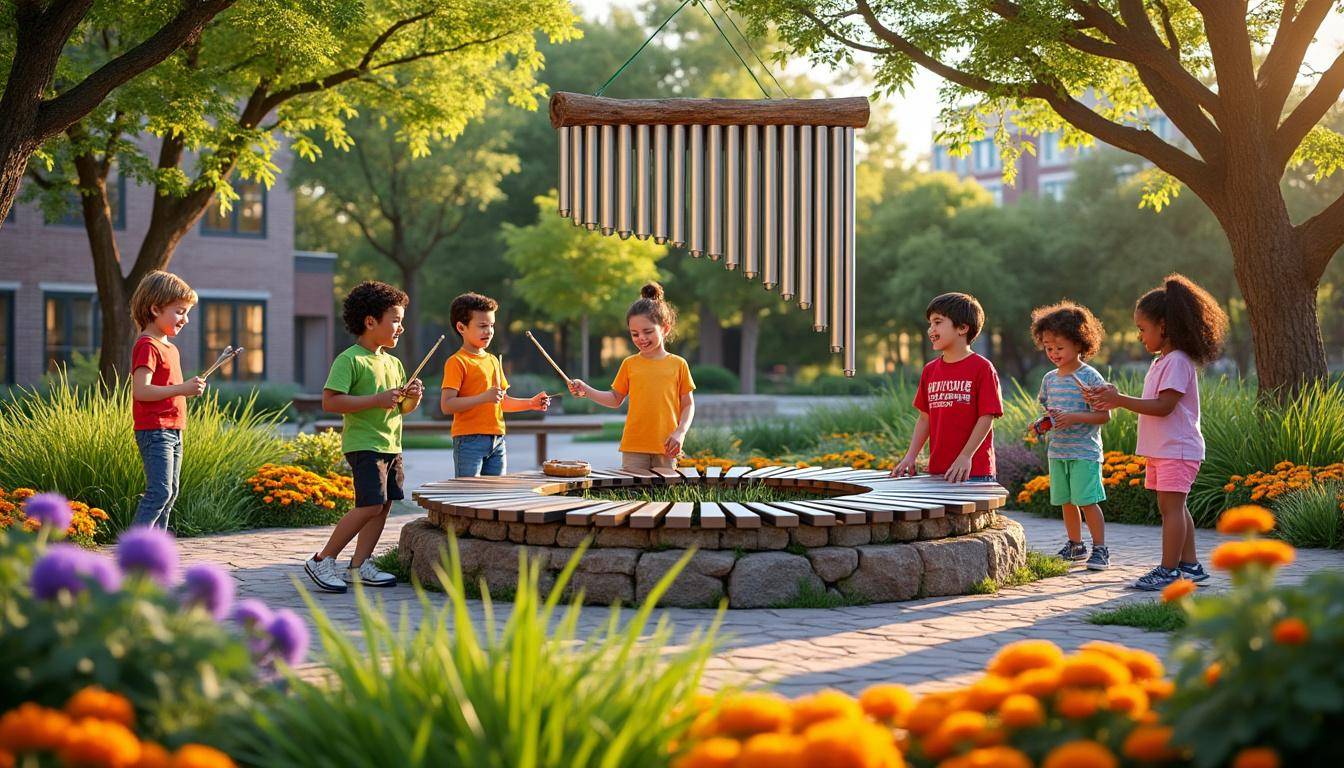
South Philly Charter School Musical Sensory Garden: Design, Funding, and Inclusive Purpose
The transformation of a small, tucked-away courtyard into a vibrant educational landscape at the South Philly Charter School demonstrates how intentional design fosters Creative Learning and supports diverse learners. This project, fueled by a grant from a local nonprofit, reimagined an underused space as a Musical Sensory Garden where children can explore sound, movement and nature in a safe, structured environment.
On arrival the space greets visitors with bright instruments, small trees, flower beds and playful sculptures. The layout intentionally separates active zones—drum clusters, chime walls, mallet stations—from quieter nooks for reflection. Those choices were driven by inclusive design principles: clear sightlines for supervision, non-slip surfaces for safety, and varied textures to invite touch without overwhelming sensory systems.
Design choices were closely aligned with the school’s mission to integrate the arts into everyday learning. The garden is not merely decorative; it is a functional Outdoor Classroom where lessons in music, science and social studies are enacted daily. Teachers can book the area for class rotations, and autistic support classes have scheduled access to ensure consistent therapeutic exposure. The garden’s architecture supports both unstructured play and scaffolded lessons.
Key physical and pedagogical features
- Instrument variety: xylophones, bongos, metal “flowers,” and hand pipes positioned to encourage collaborative rhythms.
- Zoning: active play corridors versus quiet reflection benches beneath a red pavilion that doubles as an outdoor teaching space.
- Sensory markers: textured paths, scent beds and tactile sculptures that invite multi-sensory engagement.
- Accessibility: level access from multiple entrances, soft turf for safe movement and visual cues for transitions.
- Daily scheduling: dedicated blocks for autistic support classes plus weekly slots for other grades.
These concrete design choices reflect research on inclusive environments and support the school’s broader commitment to Sensory Education. Educational leaders prioritized flexibility so the same instrument cluster can be used for a kindergarten rhythm exercise, a middle-grade physics lesson on sound waves, or a small-group therapy session focused on social turn-taking.
Because this is a public charter in a dense urban setting, the garden also represents wise use of limited outdoor acreage. The project required negotiating fencing, safety protocols and daily access routines to keep the space therapeutically calm while remaining open to general education. That balance was central to the garden’s purpose: provide a therapeutic haven that also functions as a hub for Student Engagement.
For school staff and families, the garden has become a visible commitment to accessible arts education. It signals that Music and Nature are not extracurricular luxuries but integral tools for student growth. This section highlights how physical design, funding strategy and inclusive aims converge in a single, practical space that supports both individualized needs and whole-class learning.
Key insight: thoughtful physical and scheduling design transforms a small urban courtyard into a multipurpose sensory and musical laboratory that supports inclusion and playful inquiry.
How a Musical Sensory Garden Stimulates Kids Creativity and Sound Exploration
When children encounter a space designed for sound, their curiosity drives experimentation. In the Musical Sensory Garden at South Philly, students move from tentative taps to full ensembles within minutes. This progression illustrates how structured access to instruments fosters both Kids Creativity and emergent musical skills. Teachers report that simple prompts—“create a rhythm that tells a story”—lead to collaborative composition and expressive play.
Research in neurodevelopment and education underscores the value of music for diverse learners. Studies show that rhythmic activities improve timing, attention and nonverbal communication, particularly for students with autism spectrum conditions. The garden’s focus on sound allows educators to design short, targeted interventions that build social reciprocity, imitation and turn-taking, while also nurturing cognitive skills like pattern recognition.
Practical activities that promote sound exploration
- Rhythmic call-and-response: One student plays a short pattern, peers imitate and then vary it. This builds listening and working memory.
- Sound mapping: Students walk a path and record loud/soft or high/low sounds to learn basic acoustics and vocabulary.
- Nature percussion: Using mallets on metal flowers or wood planks to compare timbre, linking Music and Nature.
- Compositional games: Small groups compose short pieces to accompany a poem or movement sequence.
- Reflection rounds: Brief sharing moments where children describe how a sound made them feel—boosts emotional literacy.
Each activity can be tailored to developmental goals. For example, a group needing sensory modulation might practice steady, low-volume drumming as an arousal regulation strategy. Another small group might explore pitch and melody for an expressive arts unit. The same instruments, therefore, support differentiated instruction.
Teachers at the school have adapted conventional lesson plans to leverage the garden’s affordances. A science lesson on vibration becomes tangible when students see mallets move bars and hear frequency differences. A language arts lesson becomes multisensory when children compose lyrics to an improvised percussion backing. These kinetic, auditory experiences create memory hooks that reinforce academic content.
Beyond academics, the garden cultivates agency. Students who may struggle with desk-based tasks often shine when handed a mallet. This shift changes classroom dynamics: peers notice competencies they might not have seen otherwise, and teachers adapt expectations. The result is stronger peer relationships and increased self-efficacy.
For educators interested in replicable approaches, resources on creative instructional methods provide frameworks to integrate music into daily routines. Practical guidance can be found through professional resources on innovative instructional approaches that explain how to scaffold creativity across subjects.
Key insight: a garden built for sound exploration converts discrete musical moments into sustained growth in communication, cognition and creativity, making music a versatile lever for learning.
Sensory Education Strategies in an Outdoor Classroom for Learning Enhancement
Translating the garden into a repeatable pedagogical framework requires clear strategies. The school’s staff developed routines that balance exploration and instruction so the space functions consistently as an Outdoor Classroom. Those routines include safety orientation, transition signals, and a menu of short, focused activities aligned with standards-based goals. This structure allows teachers to tap the garden for targeted lessons while preserving space for free play.
One practical strategy is micro-teaching: a 10–15 minute targeted activity that focuses on a single objective—listening for pitch changes, practicing turn-taking, or observing cause and effect. Micro-teaching fits into daily schedules without consuming large blocks of instructional time. Over weeks, these micro-lessons accumulate into measurable growth.
Teacher tools and assessment approaches
- Observation rubrics: simple checklists for social interaction, communication initiation and engagement during 10-minute rotations.
- Student journals: pictorial or short written reflections after outdoor sessions to reinforce learning and recall.
- Peer-assessment: guided prompts where classmates offer positive feedback on collaborative music pieces.
- Data collection cycles: small data points collected weekly to inform IEP goals or group instruction decisions.
- Family involvement: take-home activities or videos that encourage continuation of Sound Exploration at home.
Embedding assessment into playful practice is crucial. For instance, using a simple three-point scale—observed, emerging, mastered—teachers can track a student’s ability to wait a turn during a drum circle. That data then informs both therapeutic supports and classroom grouping decisions.
Professional development is also essential. Teachers benefit from short modules that show how to convert standards-based learning into sensory music experiences. Content that links concrete examples to research-backed methods improves confidence and uptake. For curriculum teams seeking inspiration, targeted guides on how to promote creativity in classrooms offer adaptable strategies; these resources reinforce the link between arts integration and measurable Learning Enhancement (strategies for creative learning).
Moreover, pairing the garden with allied services—speech therapy, occupational therapy and behavioral supports—creates interdisciplinary learning opportunities. Therapists and teachers can co-plan sessions where music reinforces language goals or sensory regulation skills. This collaborative model magnifies impact without duplicating effort.
Finally, simple classroom-to-garden lesson sequences help cement learning. A classroom rhythm exercise followed by a garden improvisation session creates continuity and transfer. Administrators at the school have documented that students who participate in these cycles demonstrate higher engagement and more accurate recall when assessed in follow-up activities.
Key insight: structured routines, embedded assessment and interdisciplinary planning convert a sensory garden into a powerful outdoor classroom that produces observable learning gains.
Student Engagement, Family Stories, and Community Impact of a Musical Sensory Garden
To illustrate the garden’s ripple effects, consider the daily arc of one student, “Mila,” a kindergartener whose confidence blossomed after weekly garden sessions. Initially shy in classroom performances, Mila began participating in small drum ensembles and proudly volunteered to lead rhythm games. Her teacher, Ms. Ramos, used short reflection prompts and home videos to build a bridge between school and family life. This anecdote demonstrates how targeted sensory experiences drive Student Engagement.
Families report that children who access the garden bring home new vocabulary and narratives about collaboration. Parents often describe an increase in willingness to try new activities and a calmer transition during afternoons. That anecdotal evidence aligns with documented outcomes in similar programs where music-based interventions improve social communication and emotional regulation.
Community partnerships and funding story
- Grant partners: the garden was made possible through a grant from the school’s nonprofit network, highlighting the role of local philanthropy in urban education.
- State support: targeted funding for sensory spaces helped cover construction and major equipment costs.
- Volunteer engagement: local musicians and parents contributed time to instrument maintenance and programming events.
- Cross-campus access: other schools in the network visit to observe best practices, strengthening district-wide capacity.
- Media and advocacy: local coverage amplified the program’s successes and encouraged replication.
Community partners also bring specialized knowledge. For instance, collaborations with local arts organizations provide workshops that train teachers in musical pedagogy and classroom management within an outdoor setting. These partnerships ensure the garden remains a dynamic learning site rather than a static play area.
On a practical level, the garden has hosted after-school events where families join small ensembles, creating cultural continuity and making the space a true community hub. Such events strengthen school-family relationships and invite broader civic participation in arts and education. Educators have used these gatherings to introduce parents to at-home activities that reinforce Sound Exploration and emotional regulation.
Stories like Mila’s ripple outward: classmates notice her leadership, teachers adapt lessons to build on observed strengths, and families gain new tools for support. The garden thus functions as a catalyst for social capital, helping students and families access arts-rich experiences that might otherwise be scarce in the neighborhood.
For schools considering similar projects, practical guides on fostering creativity provide helpful planning frameworks and can be consulted to shape family engagement programs (guide to promoting creativity in schools).
Key insight: by fostering meaningful student experiences and sustaining community partnerships, a musical sensory garden becomes a locus of engagement that strengthens school-family bonds and civic support for arts-based learning.
Scaling and Sustaining Musical Sensory Gardens: Best Practices and Practical Next Steps for Schools
Scaling a successful pilot into a sustainable program requires attention to design, maintenance, funding, curriculum alignment and professional development. The South Philly example provides a roadmap: begin with a clear instructional purpose, secure diversified funding, and design for accessibility and adaptability. These steps ensure long-term impact and broad utility across grade levels.
Financial planning must include initial capital and recurring maintenance costs. Durable outdoor instruments and weather-resistant finishes reduce replacement frequency, while training volunteers to perform routine upkeep minimizes long-term expenses. Schools should also budget for teacher release time to plan integrated units that use garden resources effectively.
Checklist for schools that want to replicate the model
- Define educational goals: identify whether the garden will prioritize sensory regulation, creative arts instruction or cross-curricular units.
- Secure funding mix: combine grants, district allocations and community fundraising to cover construction and ongoing programming.
- Plan for maintenance: choose durable materials and set a maintenance calendar with staff or volunteer leads.
- Professional development: invest in short workshops that connect music activities to standards-based goals.
- Evaluation: implement simple monitoring tools to capture engagement and learning outcomes over time.
Partnerships with arts organizations and universities can provide both expertise and evaluation support. For example, university music education departments often assist with curriculum mapping and outcome measurement. Nonprofits experienced in Sensory Education offer templates and procurement guidance for instrument selection, helping schools avoid costly mistakes.
Additionally, schools should consider policy and safety protocols. Establishing clear access rules, weather contingency plans and supervision ratios ensures that the garden remains welcoming and secure. Administrators should also build inclusive booking systems so that therapeutic groups retain priority while other classes access the space regularly.
Finally, sustainability hinges on storytelling. Documenting student work, sharing family testimonials and publicizing measurable outcomes help attract future funding and community support. Practical resources that outline creative instructional methods assist leaders in building a compelling narrative for stakeholders; these materials can be useful references during planning and fundraising (creative instructional approaches resource).
By following these guidelines, schools can replicate the dual benefits of a Musical Sensory Garden: providing therapeutic spaces for students with specialized needs and enriching everyday curriculum with hands-on sound exploration. The investment yields clear returns in Learning Enhancement, social skills and community engagement.
Key insight: with deliberate planning, diverse funding and strong partnerships, musical sensory gardens can be scaled as sustainable outdoor classrooms that deliver lasting educational and social benefits.